Lunchbox Range Design & Development · Newell Brands - Sistema, NZ · 2024–26
Heatables
Microwave safe food containers
End-to-end NPD lead for a $40M USD revenue target (3 YR) — from consumer research and product strategy through to launch-ready SKUs already on shelves at select ANZ retailers, with full launch across ANZ, NA, and EMEA by June 2026. Co-inventor of a patent-pending lever mechanism that solved a critical usability-performance trade-off in leakproof lunchbox design.
Project Summary
Problem
No leakproof, microwave-safe adult lunchbox in the Sistema range.
My Role
End-to-end NPD lead — research, concept, IP, design, and launch as the technical and design resource across 5 functions.
Outcome
8 SKUs, $40M USD target, 90%+ consumer validation, 1 patent co-invented.
Research & Analysis
User Research
Target Demographic: Adults in the workforce — men and women, ages 26–60
Research Approach
A mixed-methods research strategy was employed to ground the design brief in real consumer behaviour and market context.
A. Market Visits
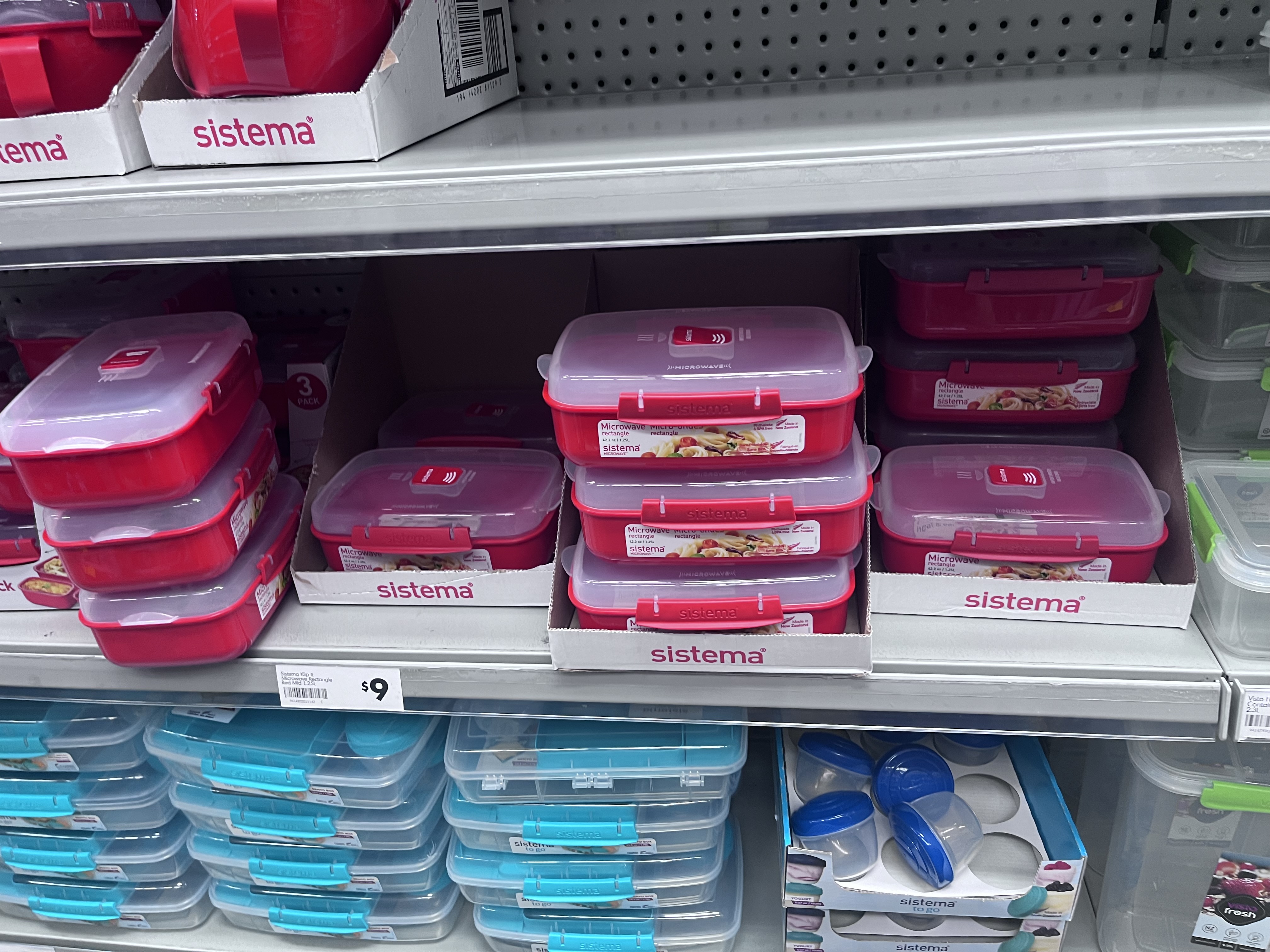
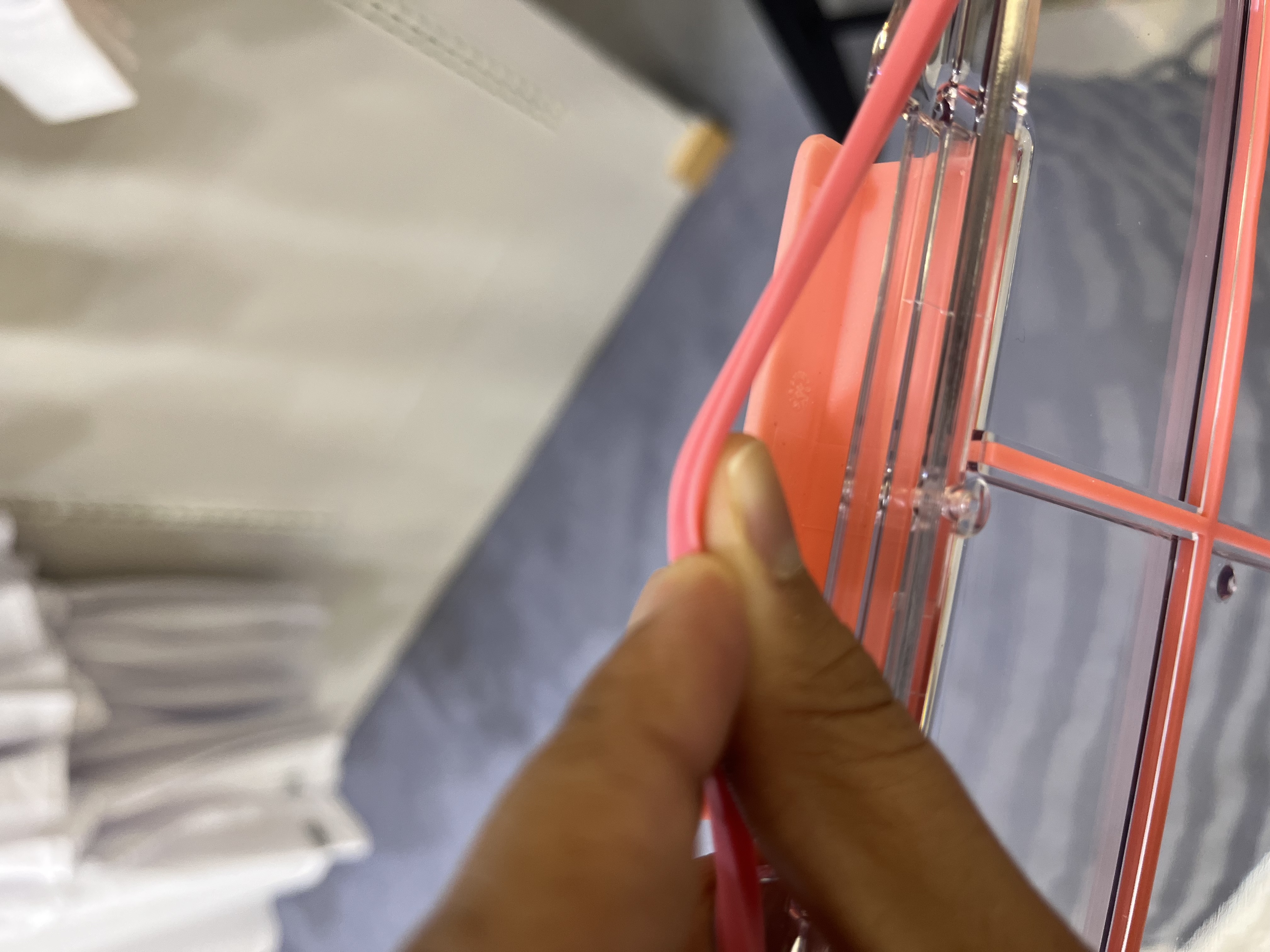
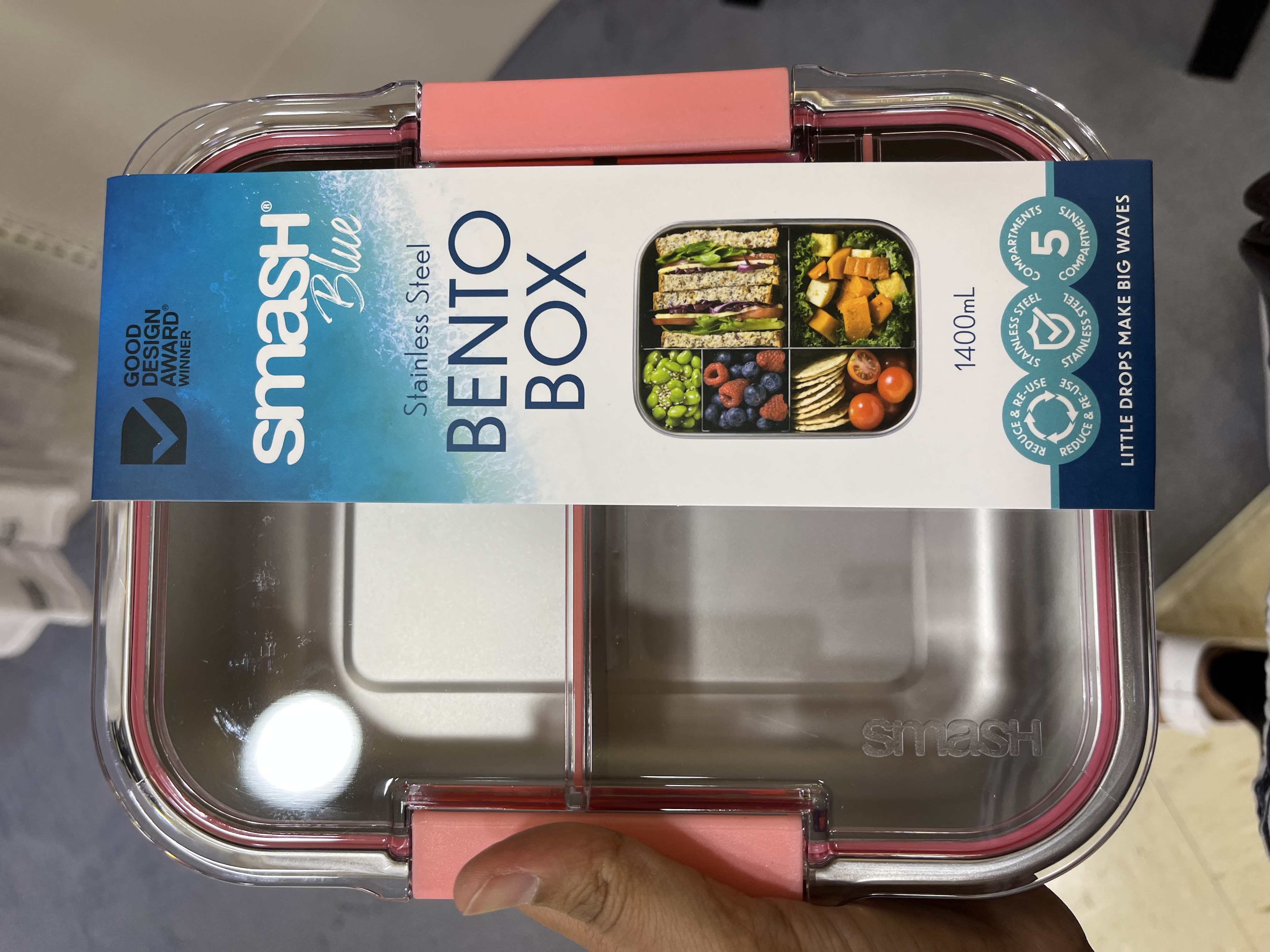
Retail audits across six Auckland stores assessed the existing lunchbox landscape, price positioning, and competitive shelf presence for the adult segment:
- Woolworths
- Farmers
- Pak'nSave
- Two Dollar Store
- Typo
- Briscoes
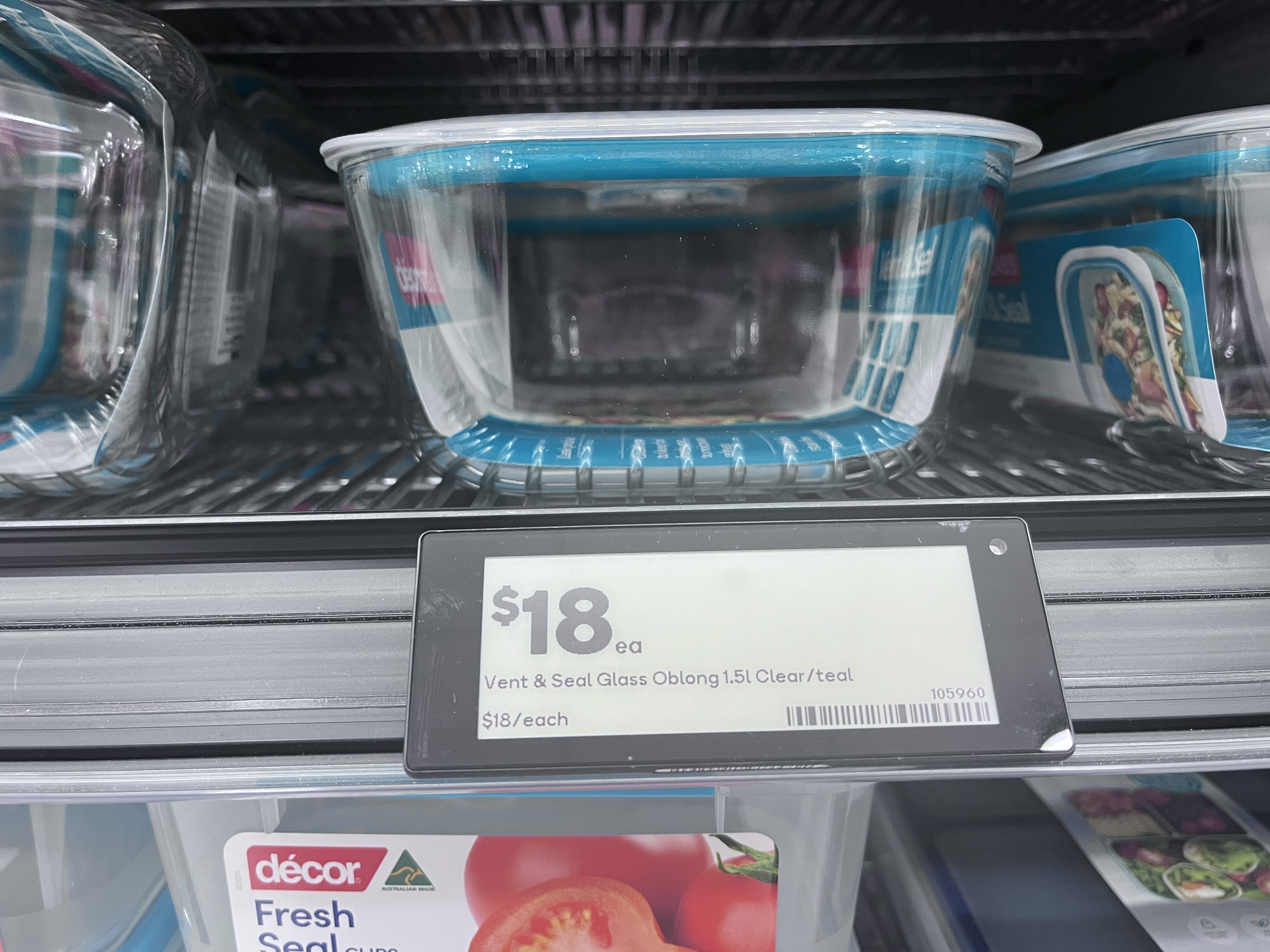
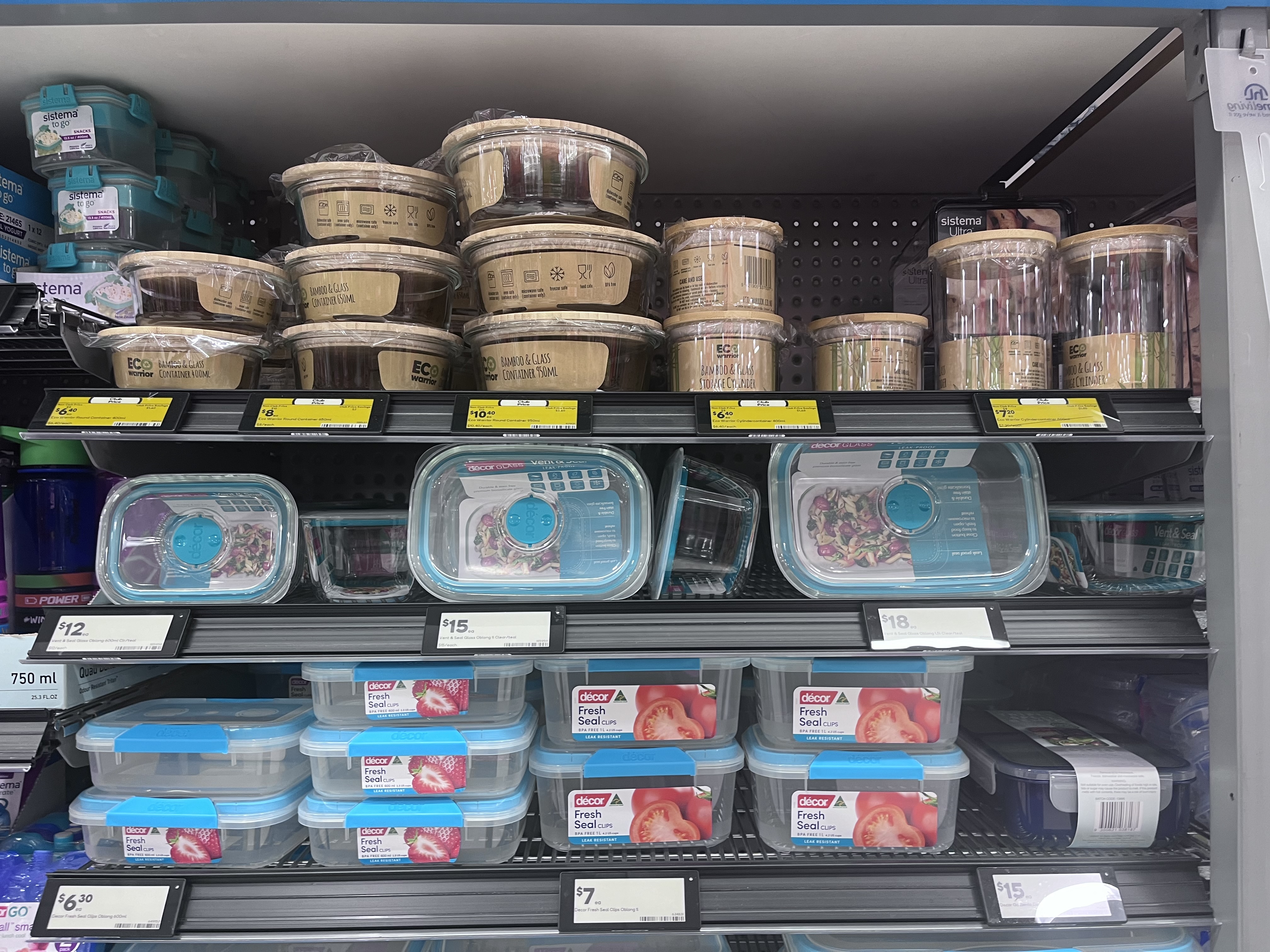
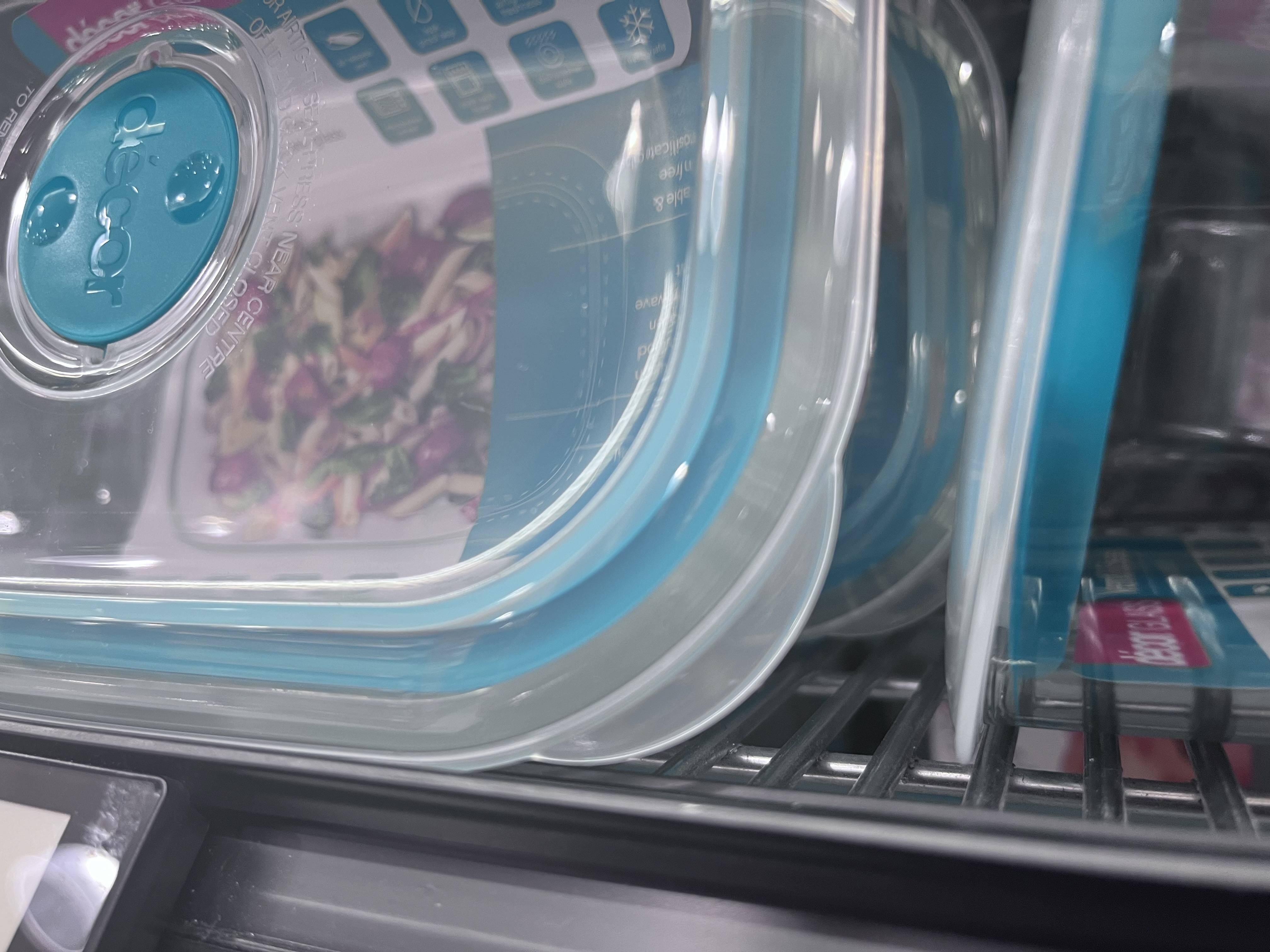
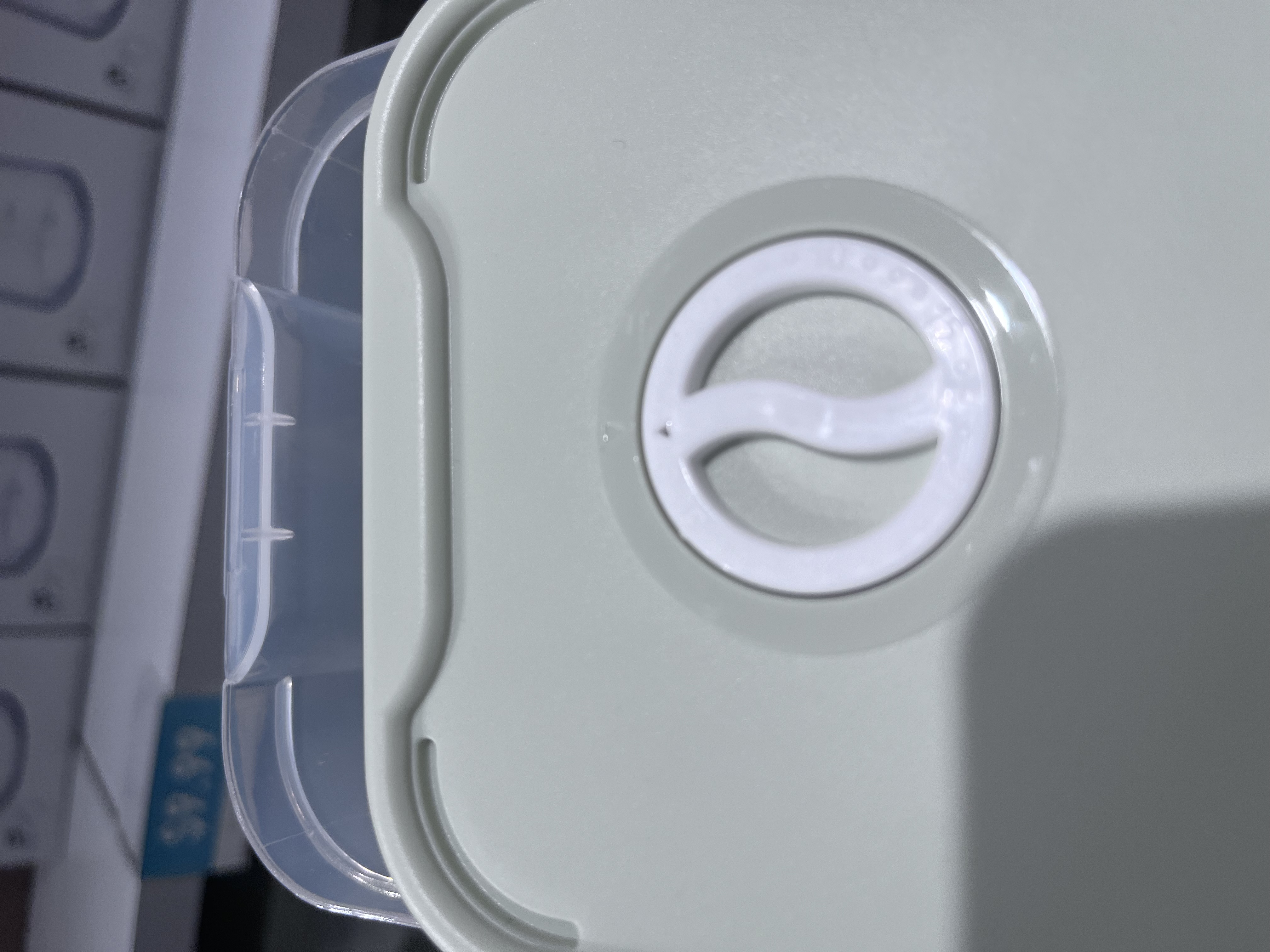
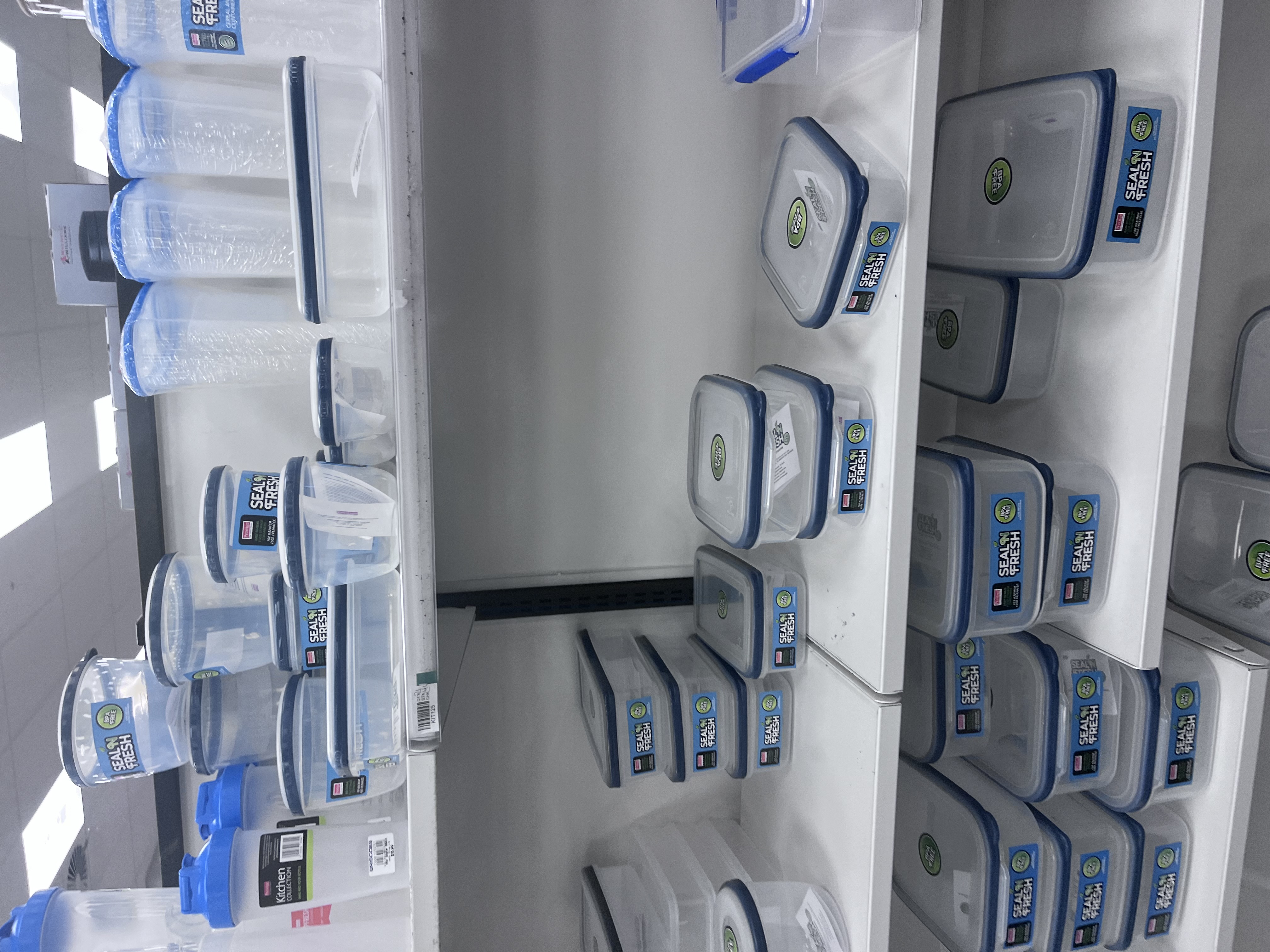
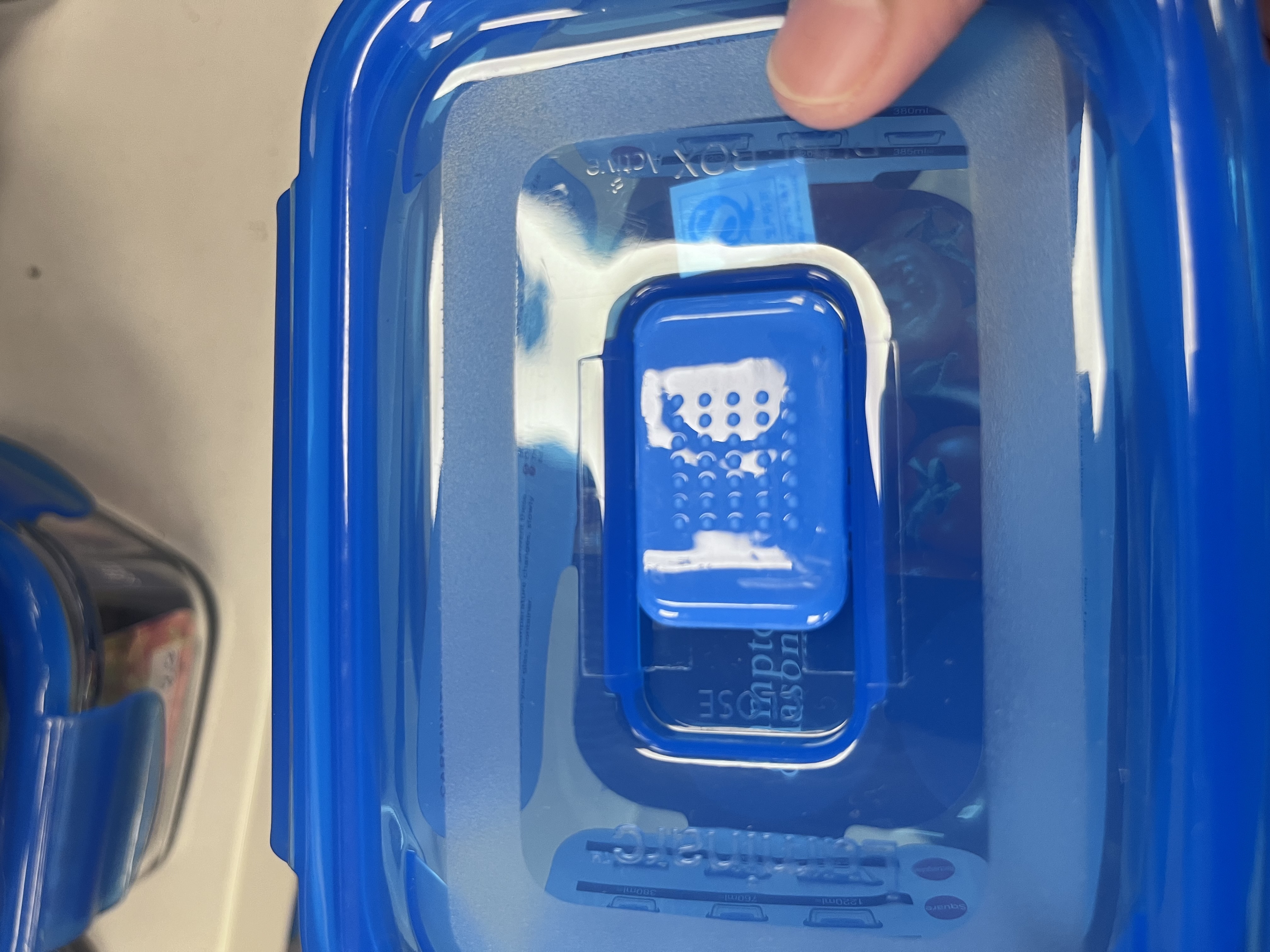
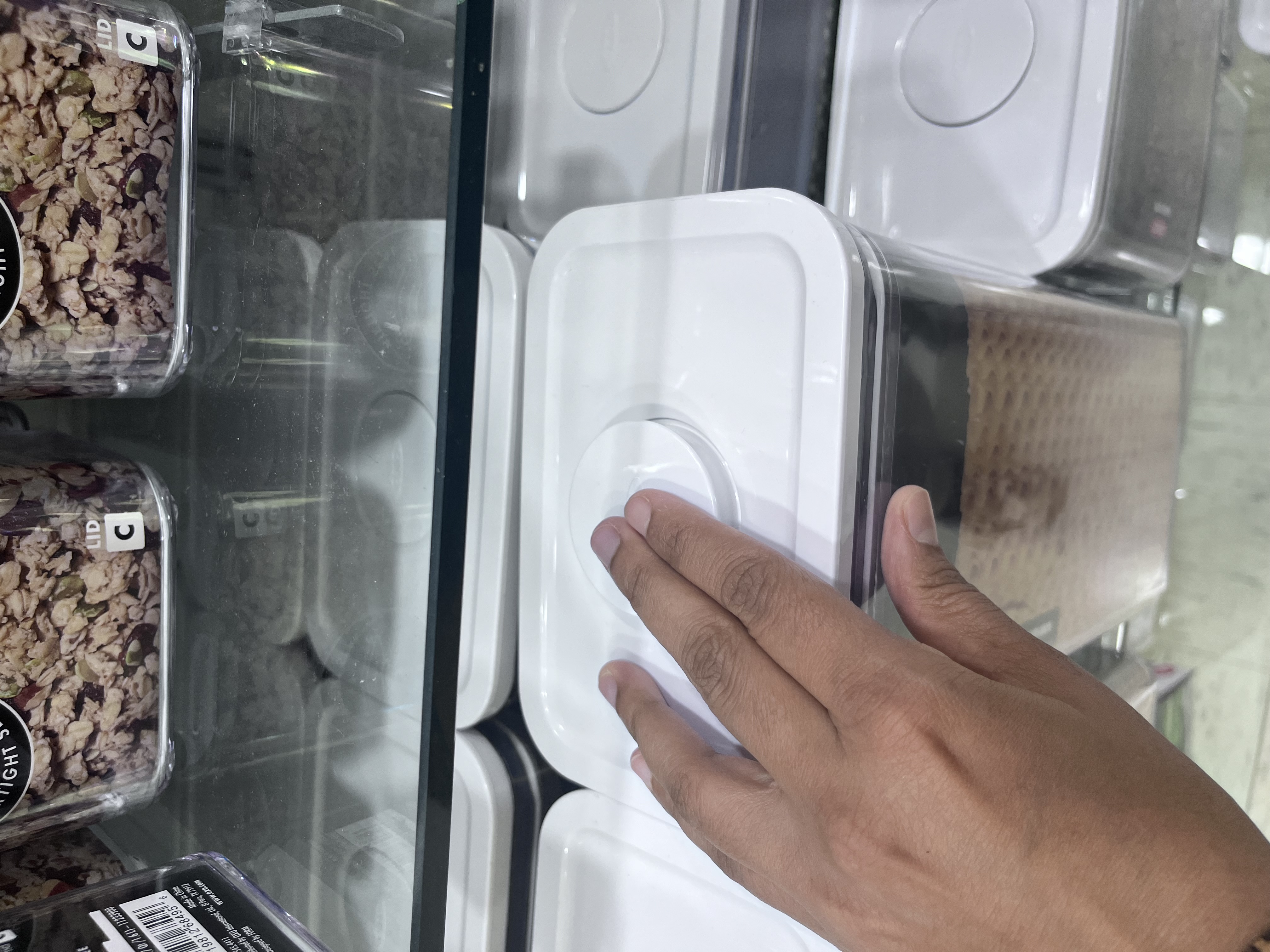
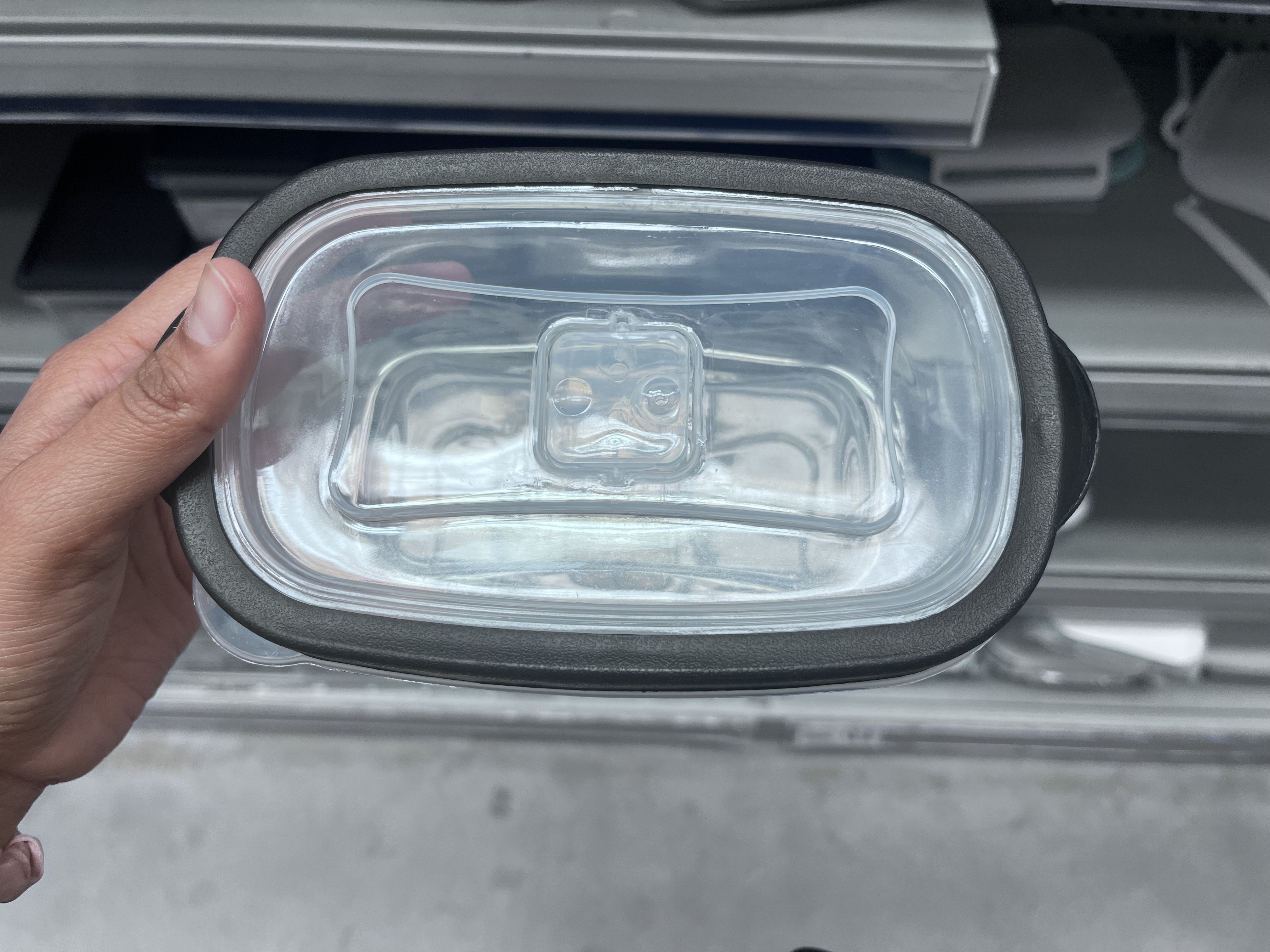
Competitive Landscape
Primary competition in ANZ: Decor. Sistema's existing range had been widely copied by private label brands — eroding shelf differentiation and shifting the brief from incremental improvement to IP-protected innovation.
Current Range — Issues Identified
-
Multiple parts — high production complexity
-
Outdated designs
-
Non-cohesive range architecture
-
Designs easily copied by private label brands
-
Design features no longer competitive
Opportunity
-
Leakproof
-
On the go
-
No labour, no loose components for inventory
-
Improved designs for reheating
-
Fresh aesthetics
B. Workplace Site Visits
- 3–5 workplaces observed over one week
- 12 lunchboxes documented in active use
- Real-world usage, storage behaviour, and product performance in context
C. Consumer Questionnaire
- n=63 respondents
- Surfaced feature priorities, functional needs, and unmet gaps
- Directly informed the design brief
Questionnaire Findings
How adults actually lunch
Beyond ranking features, the questionnaire surfaced four behavioural patterns that directly shaped the design brief — what people eat, how much they pack, whether they reheat, and how they store their food at work.
Q What do you generally have in your lunchbox?
Q Do you generally heat your meals in the microwave?
Q How many items do you pack for lunch generally?
Q Do you store your lunchbox in the workplace refrigerator?
Consumer questionnaire insights — n=48
48% answered Bowl / Container type — 90% also preferred warm meals
58% answered Yup (store in fridge) — 89% also preferred warm meals
34% answered 15–30 mins prep time — 91% also preferred warm meals
64% answered 1 to 2 items packed — 95% also preferred warm meals
Cross-question correlation — majority who selected each option also preferred warm meals (Q5)
Q Which lunchbox type do you currently use?
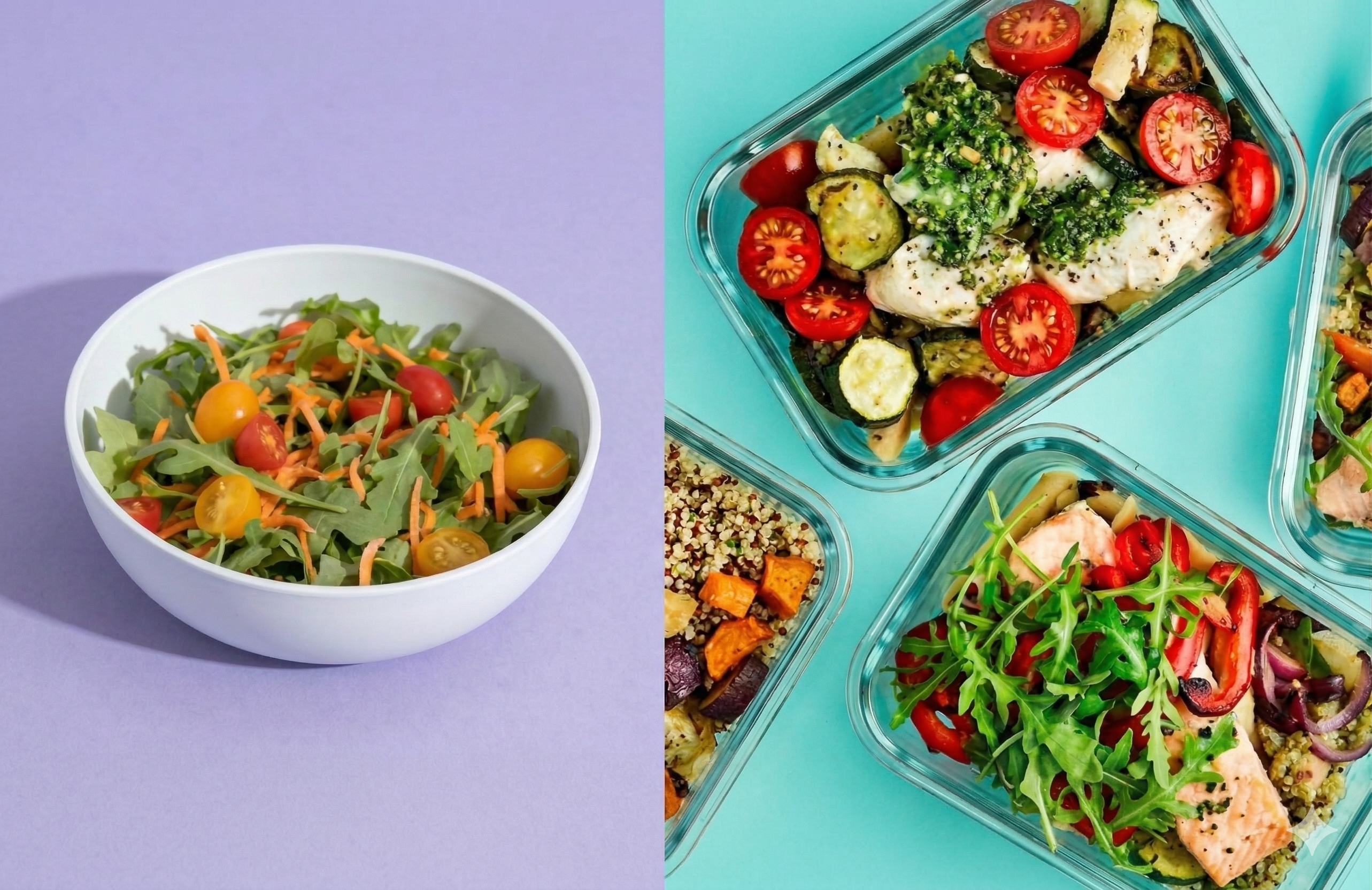
Bowl / Container
47.6%
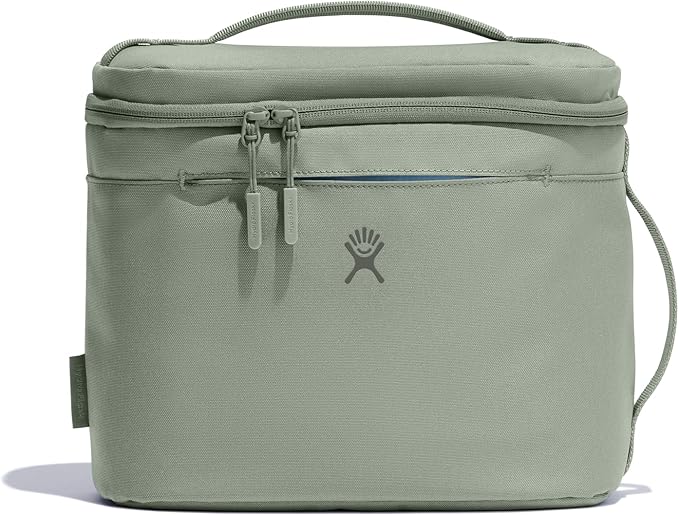
Bag type
30.2%
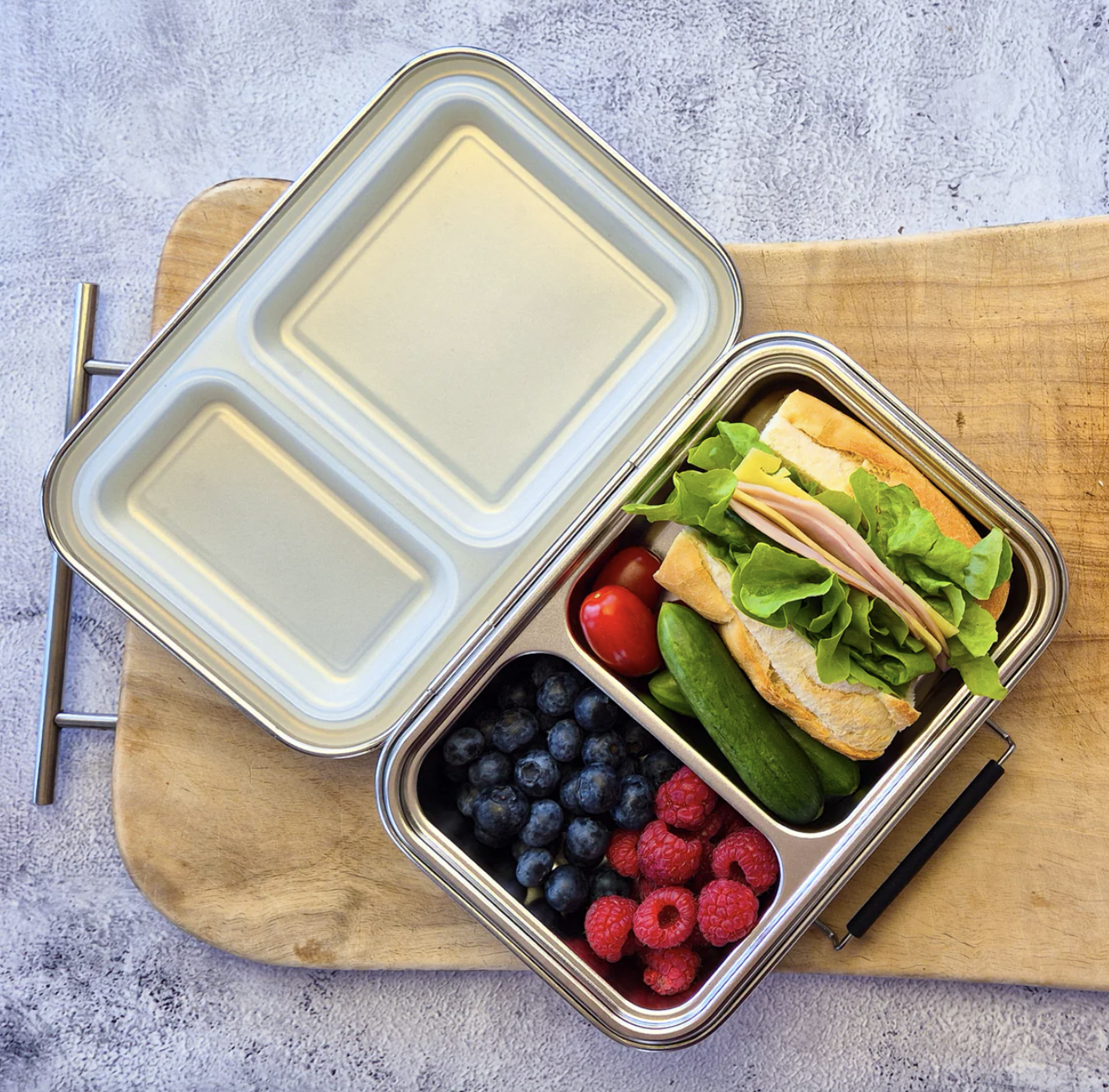
1–2 divisions
15.9%
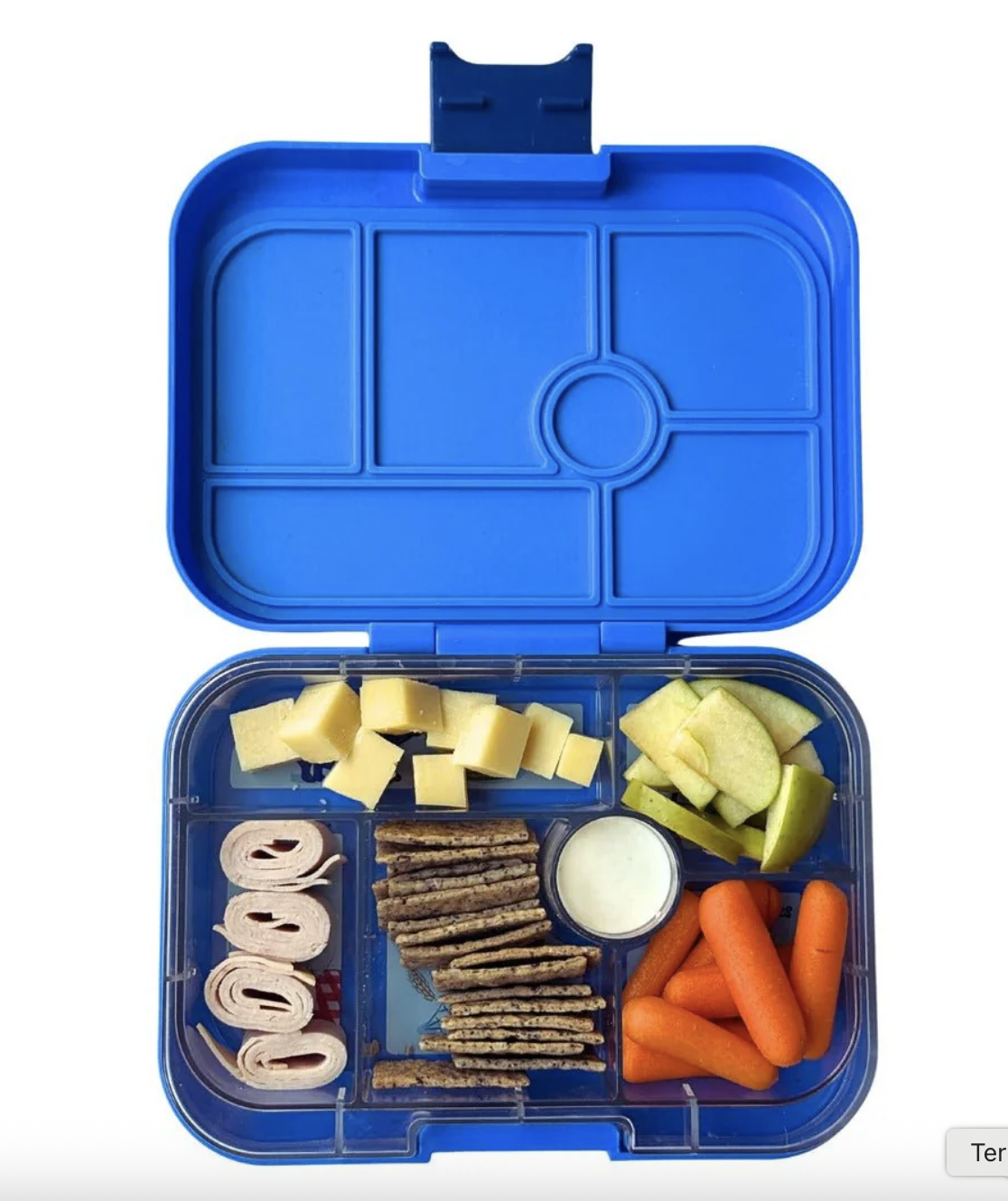
Bento type
3.2%
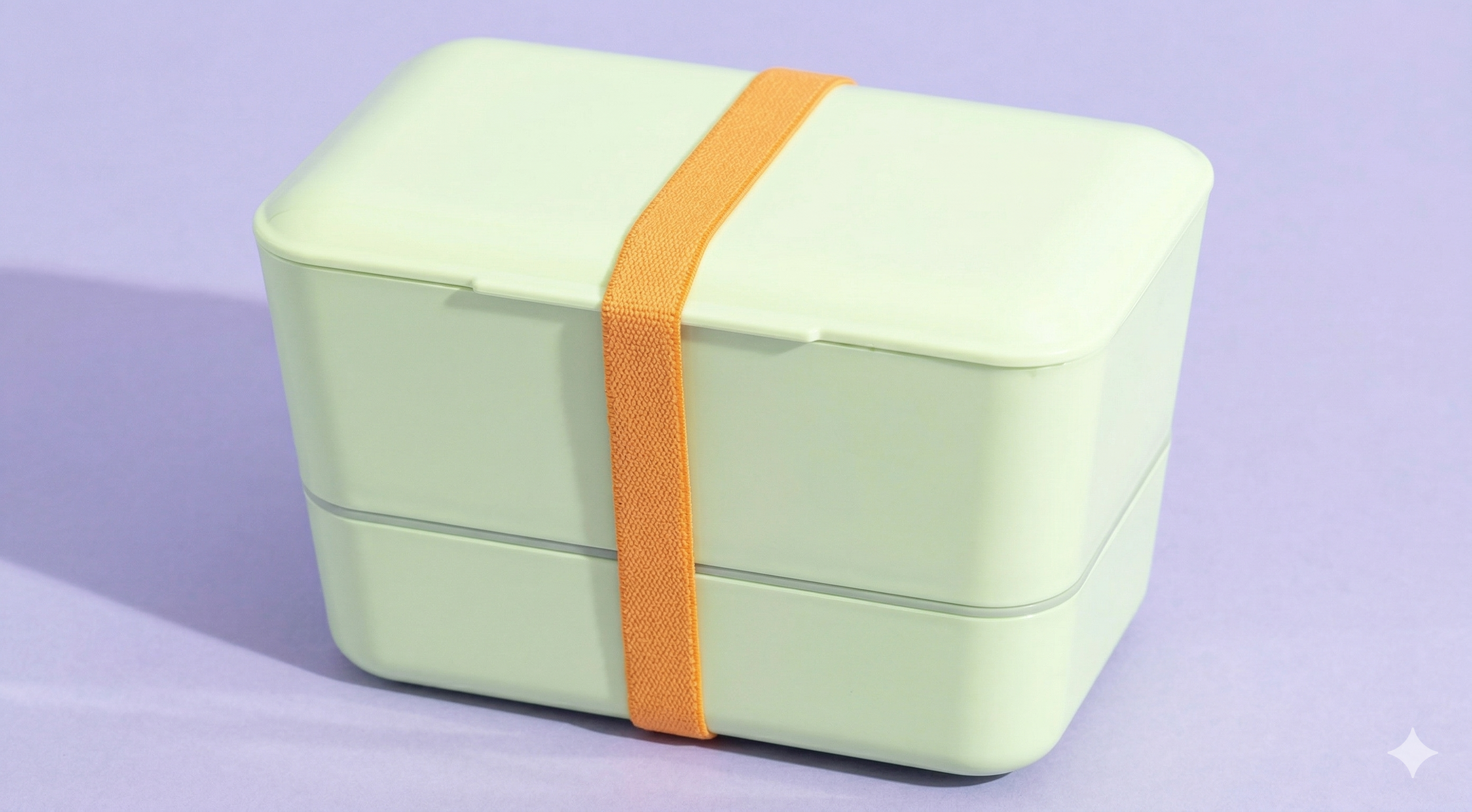
Stack type
3.2%
Lunchbox type currently used — n=63
Q What do you desire most in a lunchbox in order of priority based on your meals and experiences?
Consumer preference ranking — n=63
Key Hypothesis
Supported by the Insights team and validated through primary research, the brief hypothesis centred on designing a lunchbox range optimised for two primary use occasions: microwave reheating and on-the-go portability — both critical to the daily routines of working adults.
Research to Design Brief
From takeaways to brief
Key Takeaways
-
1.
51% always bring a lunchbox to work — confirmed daily use occasion
-
2.
58% carry leftovers — a divided, reheatable container is the core need
-
3.
79% prefer warm meals — microwave compatibility is non-negotiable
-
4.
52% rank leakproof #1 — portability is a close second
-
5.
Warm-meal packer, 1–2 items, fridge user, bag carrier — this is the target user
Design Brief
-
1.
1–2 divisions
-
2.
Microwave safe / reheatable
-
3.
Leakproof — wiper seal with easy-open mechanism
-
4.
Lunch bag compatible, stackable in fridge
-
5.
No ice pack required
Insight & Ideation
From insight to concept
Research findings directly informed the concept direction — an adult-first lunchbox range engineered around portion control, leakproof performance, and modular flexibility for the modern workday.
User research and secondary analysis of existing leakproof bento products revealed a critical friction point: while the wiper seal delivered strong leakproof performance, it significantly compromised the opening experience — making the lunchbox unnecessarily difficult to use day-to-day.
The design challenge became clear: solve for usability without sacrificing performance.
Concept Exploration
Ideation
Three concept directions were developed as low-fidelity CAD models to communicate the initial idea: a 2-shot injection moulding process with a live hinge in polypropylene. The three directions — Bold, Bolder, and Boldest — explored progressive levels of form confidence, from a minimal enclosed profile to a more expressive, divided container architecture.
Following technical review with Engineering teams — and drawing on experience from previous live hinge products in the range — it was determined that a PP live hinge carries a high fail rate under repetitive microwave heat cycling. The project direction then pivoted to a separate-part lid and base, opening the path to a 3-shot tooling solution and the clip mechanism that became the defining innovation of the range.
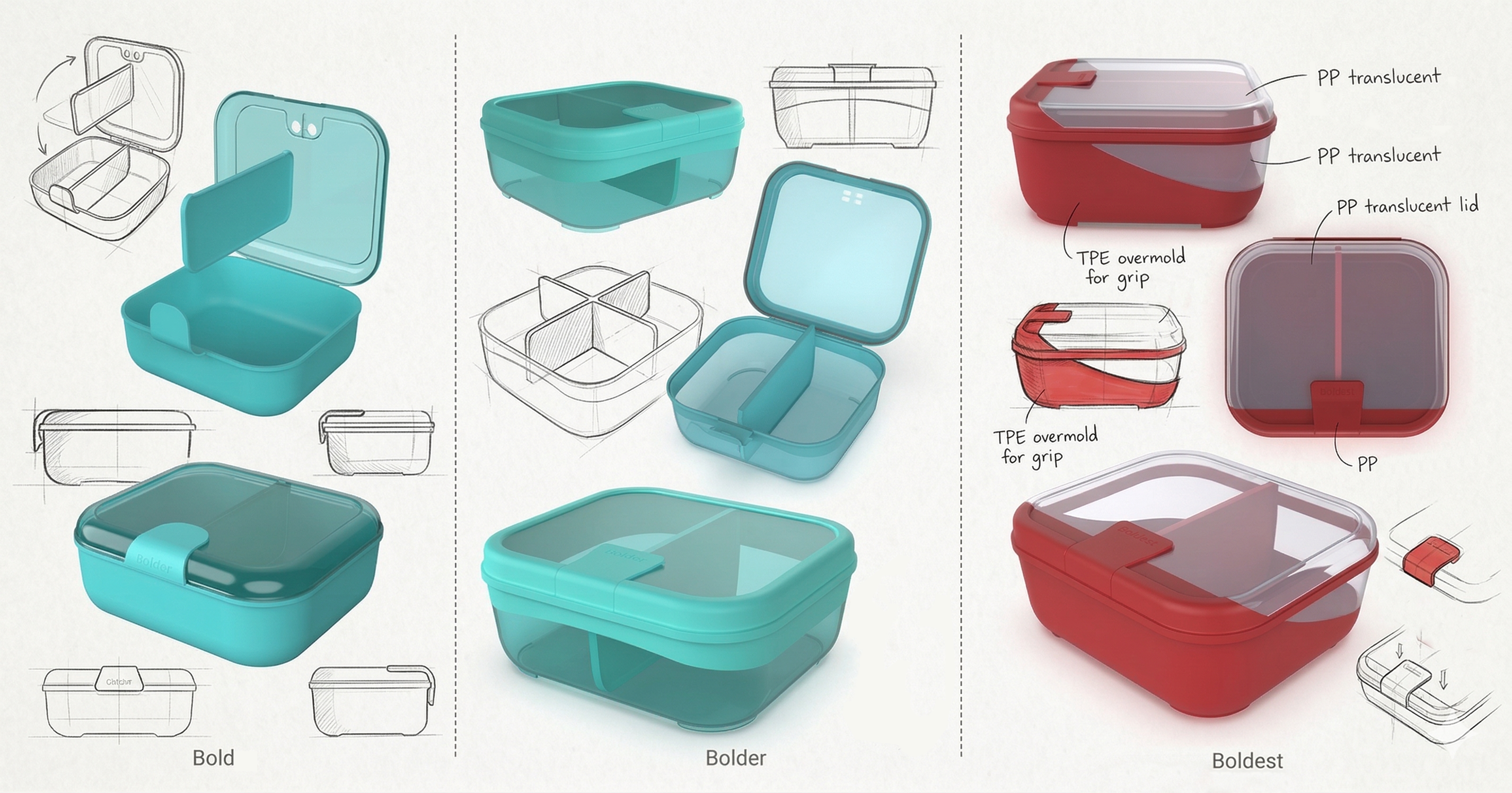
Initial concept directions (left to right): Bold · Bolder · Boldest — 2-shot PP live hinge, low-fi CAD models
Mechanism Design
The lever clip — Core Product Detail
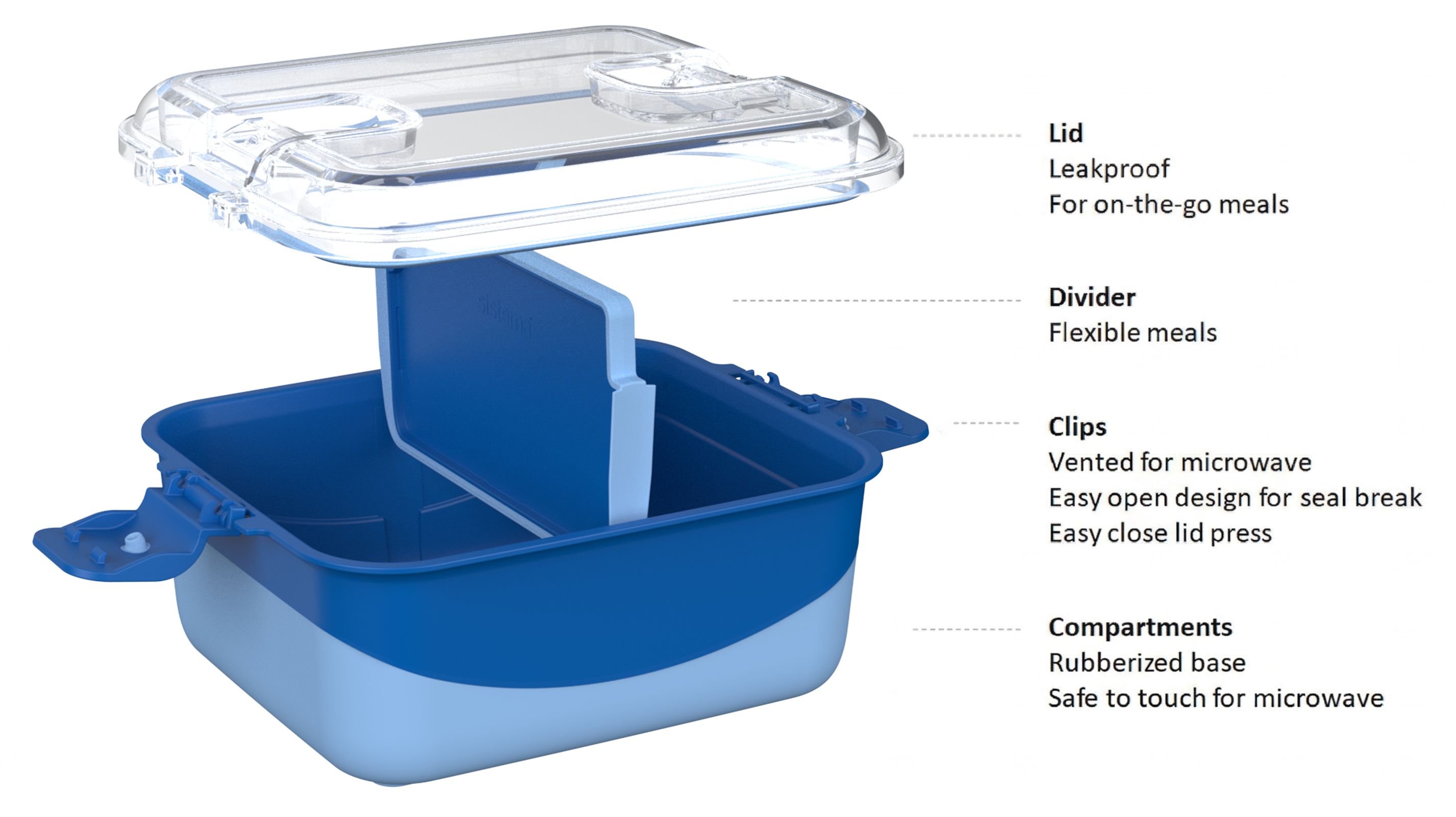
The integrated lever is moulded directly into the clip body — eliminating any separate component while reducing the opening force required.
IP-protected by design — the lever mechanism patent creates a competitive moat private-label brands cannot cross. Differentiation is functional, not just aesthetic.
Left: Clip detail in PP with rib extension that engages with the lid part to push it upwards as it opens. Right: Lid detail showing the part that engages with the lid lever rib to push open the lid.
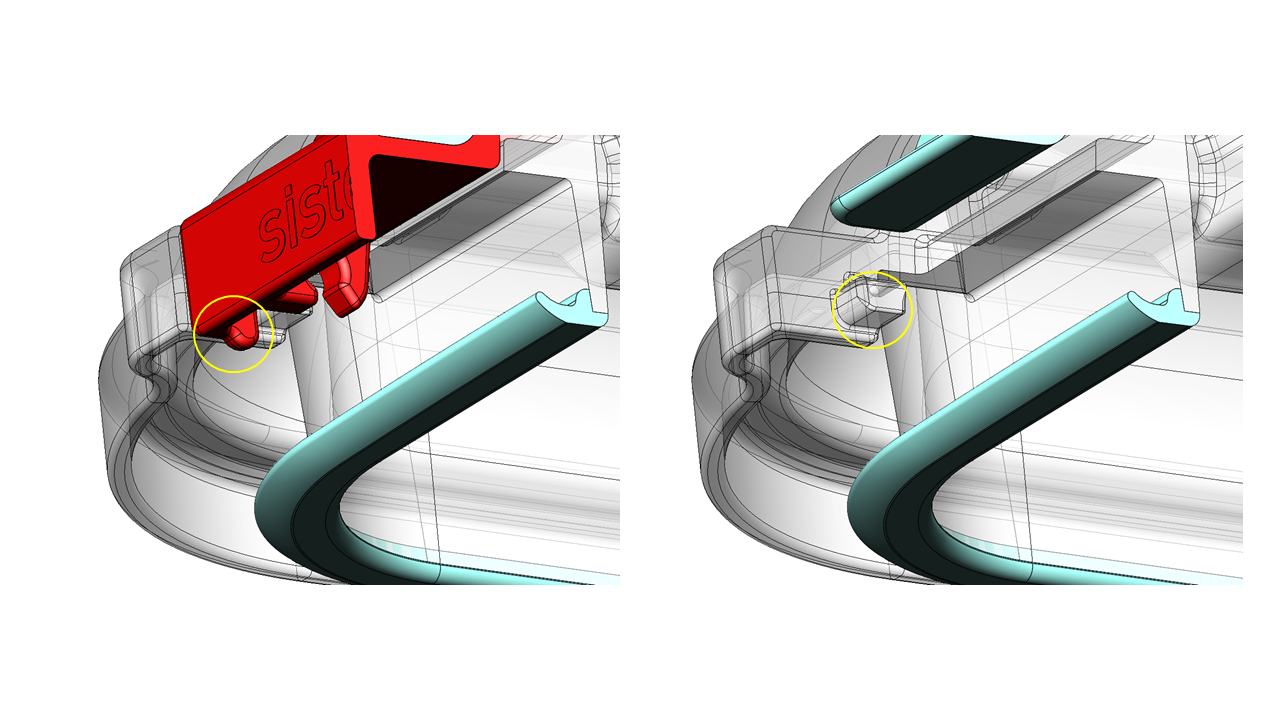
Patent-pending lever clip — CAD cross-section showing pivot geometry
Multiple ideation rounds explored ways to reduce the effort required to open the seal. The winning solution was an integrated lever feature on the lift mechanism — a simple, intuitive addition that makes the lunchbox effortless to open while fully maintaining its leakproof integrity and passing all required performance testing qualifications.
Patent-pending co-invention — the integrated lever lift mechanism is filed with Sistema's Legal and Regulatory teams, with Shruti named as co-inventor.
Range Design
Design intentions across the range
Each product in the range was designed around a specific use occasion — the clip mechanism for everyday leakproof carry, round formats for portion-controlled nesting and compact storage, and the steamer insert for hot meal preparation at the desk.
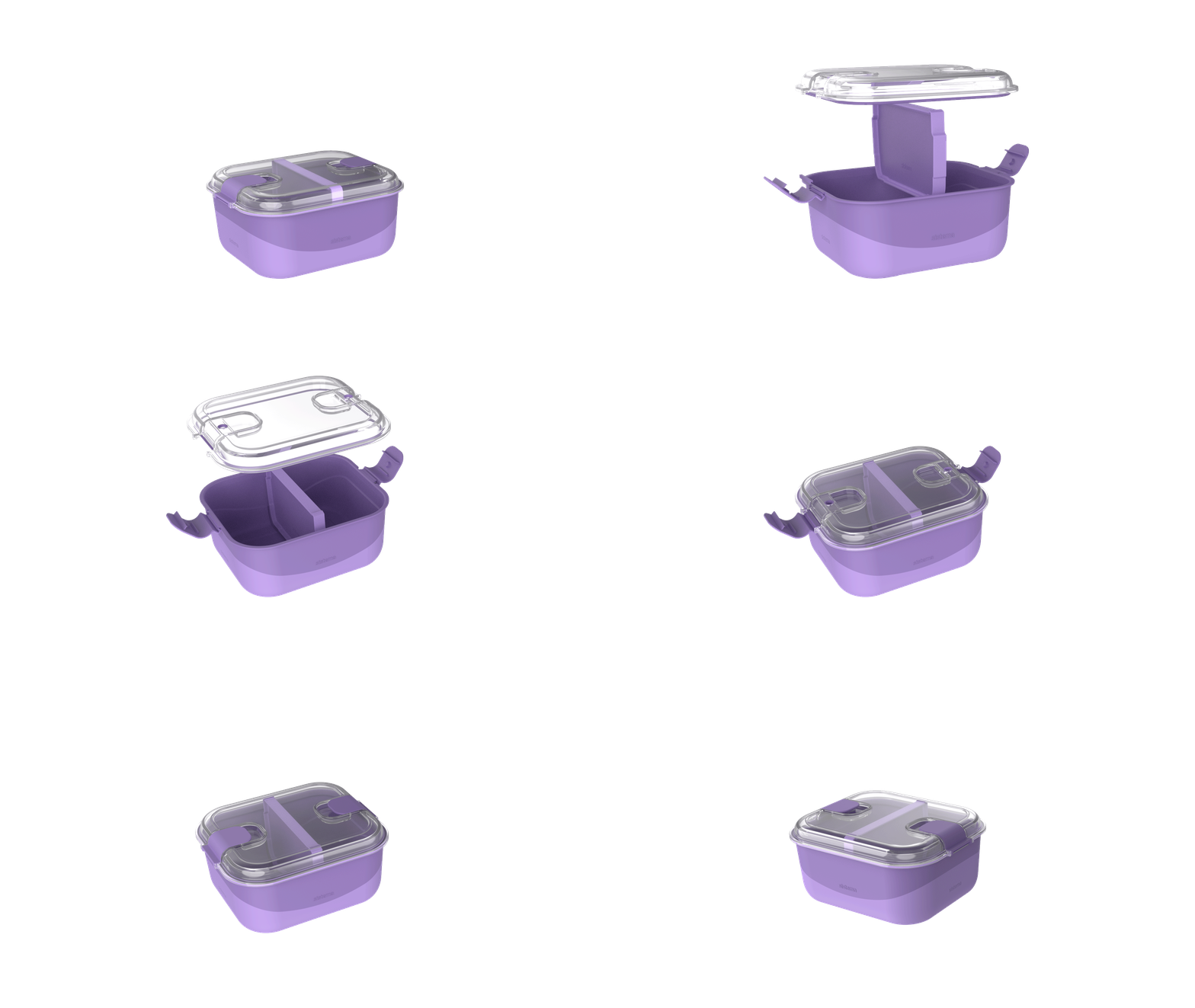
Lever clip — leakproof carry, easy open
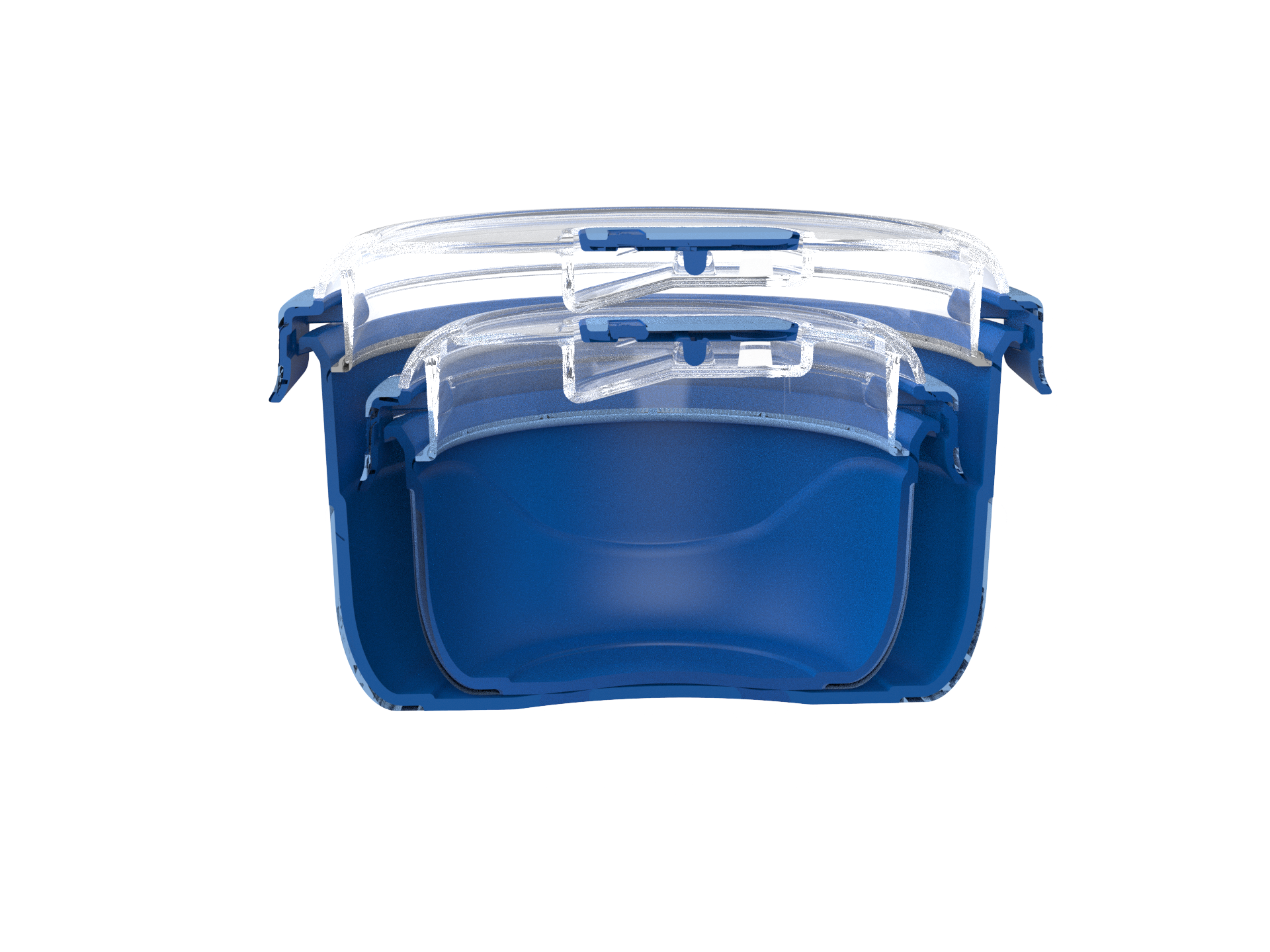
Round nesting 2-pack — compact storage
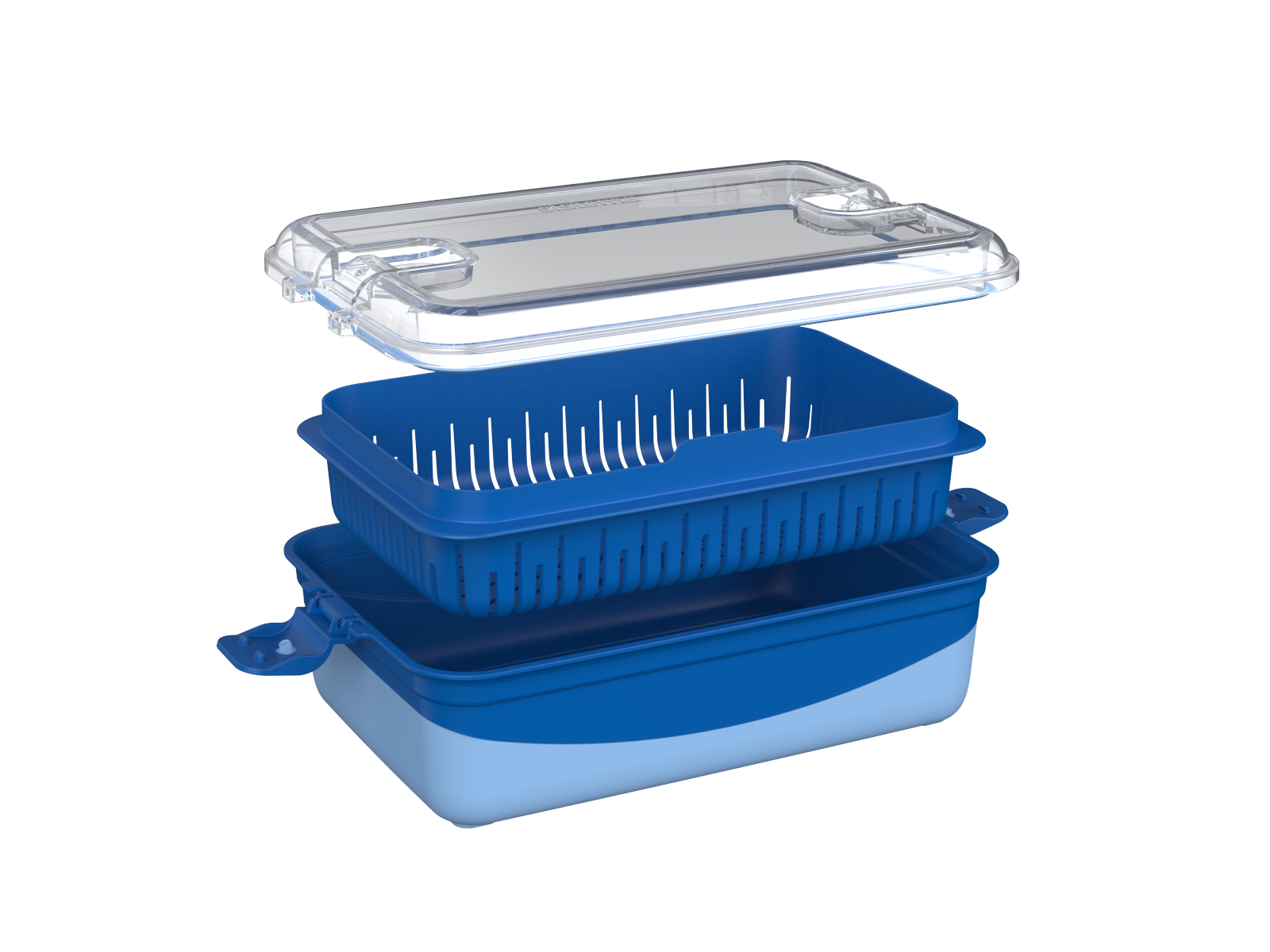
Steamer insert — hot meal prep, microwave-ready
Product Design
Features engineered around the brief
Every feature traces back to a research finding — from the wiper seal's leakproof performance to the microwave-safe base, the integrated handle, and the clip mechanism that resolves the usability-performance tension.
Prototyping
SLA prototypes — validating form and fit
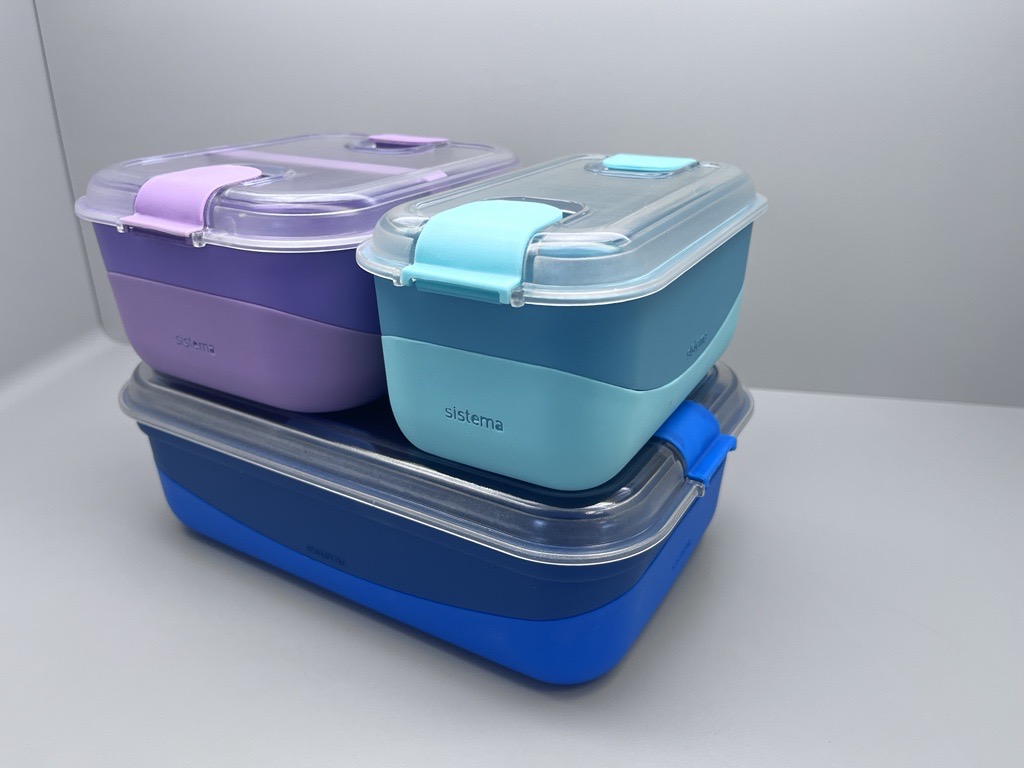
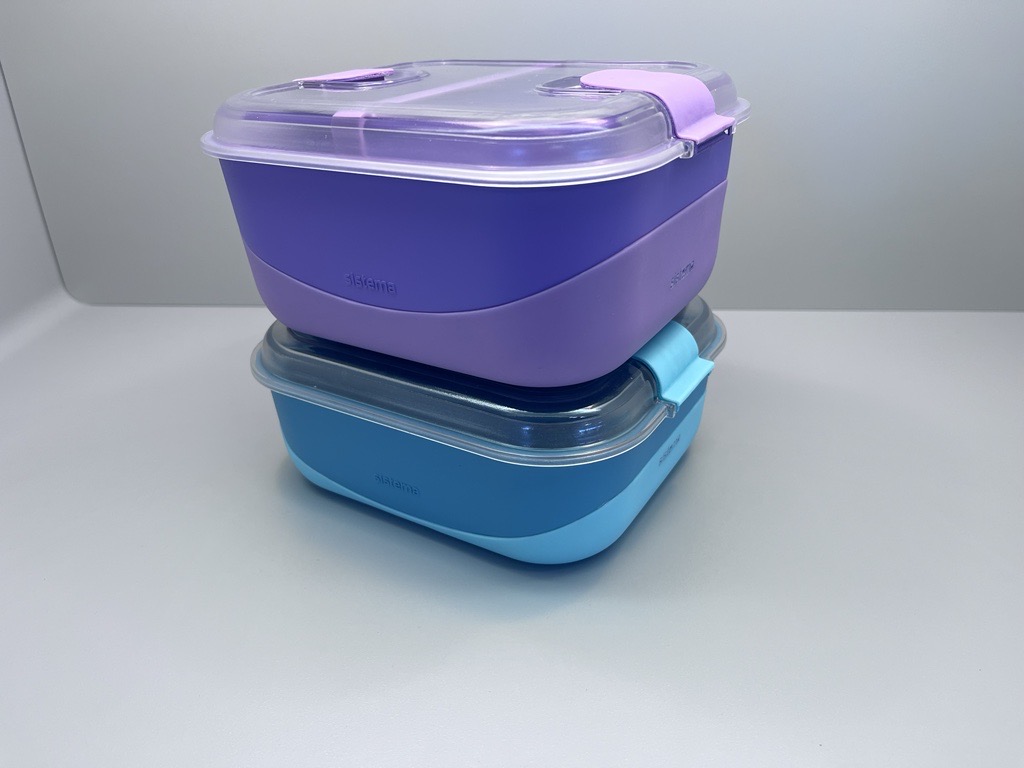
High-fidelity SLA prototypes were produced to validate final form language, clip ergonomics, and stacking configuration ahead of tooling sign-off. Prototypes were reviewed with R&D, CMF, and Manufacturing teams as part of the stage-gate process.
Two design changes surfaced through SLA review and tooling evaluation:
- PP rib added to clip interior — ensures TPE overmould fills cleanly and consistently during the 3-shot process
- Wall added to external clip face — conceals hinge detail, improves tooling quality, and created a dedicated logo zone for planogram presence when the product faces sideways in pack
CMF
Colour, material & finish
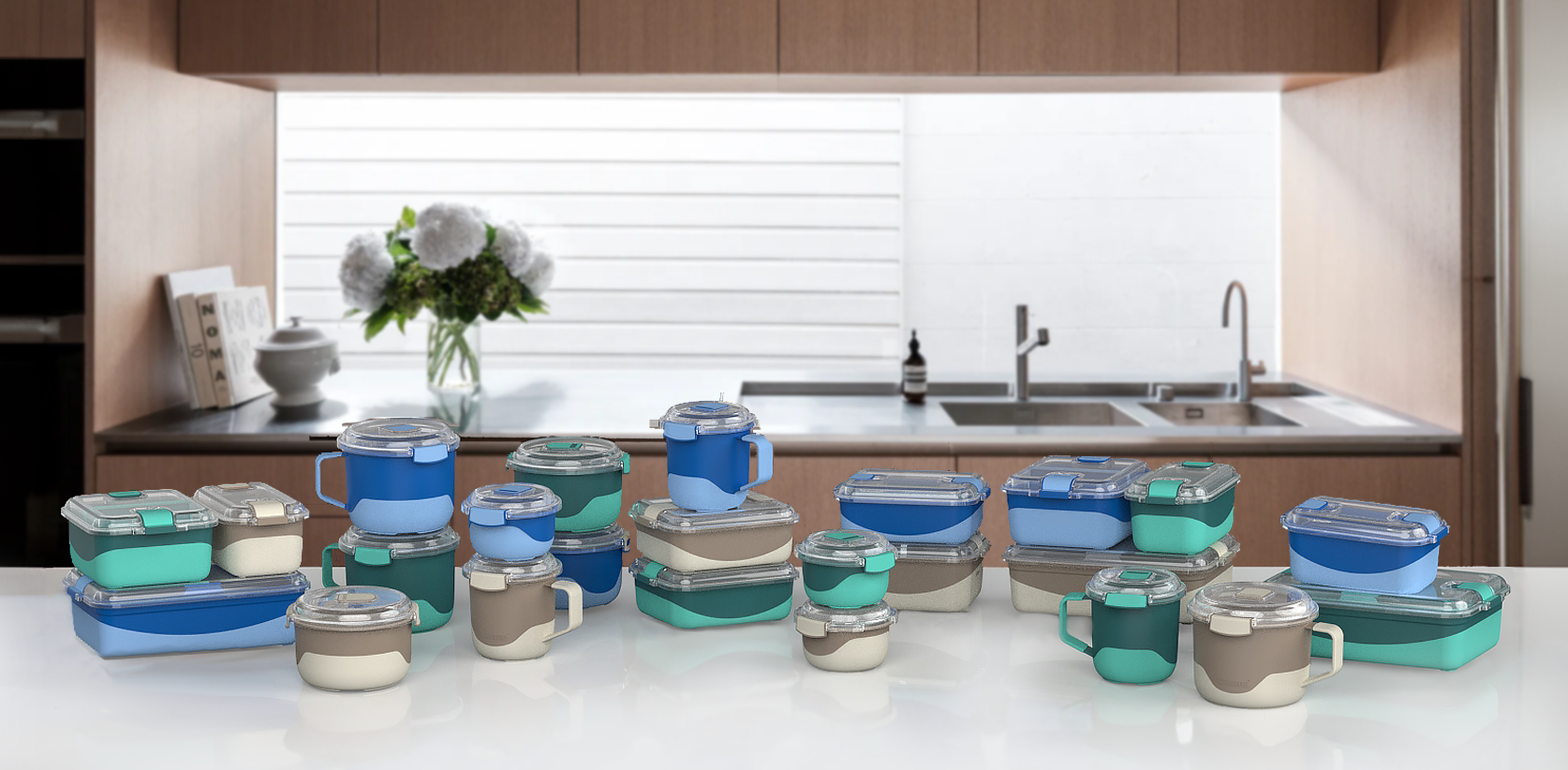
The three colourways — teal, navy, and purple — sit within the broader colour categories standard to Sistema and the food storage category, selected specifically for their appeal to the adult demographic.
A key CMF insight shaped the colour application strategy: microwave use with food items such as tomato-based sauces causes discolouration on internal PP surfaces. While harmless, this staining renders the container visually unpleasant well before the end of its functional lifespan. To mitigate this, the PP substrate was specified in a darker tint to absorb staining without showing it, while the TPE overmould was applied in the lighter tint — preserving the fresh, two-tone aesthetic that defines the range. This decision was made in collaboration with the CMF team; the discolouration insight was a direct contribution from Shruti as design lead.
Teal
Dark tint — PP base & clip body
Light tint — TPE overmould
Navy
Dark tint — PP base & clip body
Light tint — TPE overmould
Purple
Dark tint — PP base & clip body
Light tint — TPE overmould
Each colourway applies the darker tint to PP and the lighter tint to TPE — a functional CMF decision to manage microwave staining over product lifespan
Range Architecture
Full SKU range
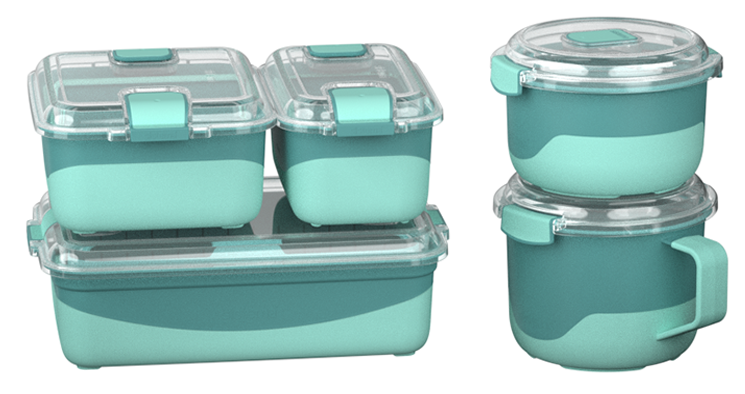
The final range comprises 8 SKUs — 4 rectangular and 4 round formats — plus 2 pack configurations, all sharing common tooling architecture to manage manufacturing cost while delivering breadth at retail.
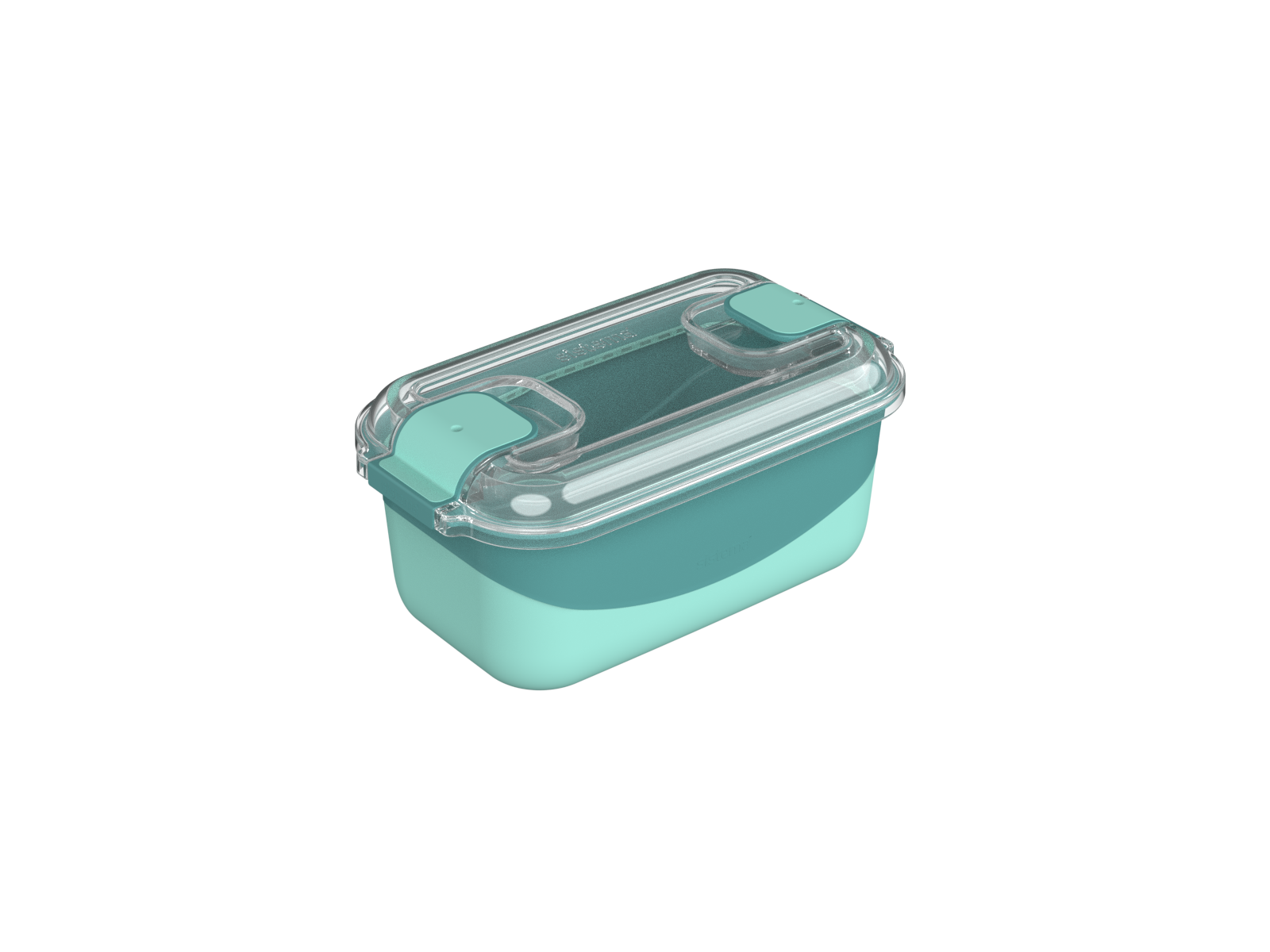
890ml Small
Small Portion
£5.99
AUD $8.99 – $12.99
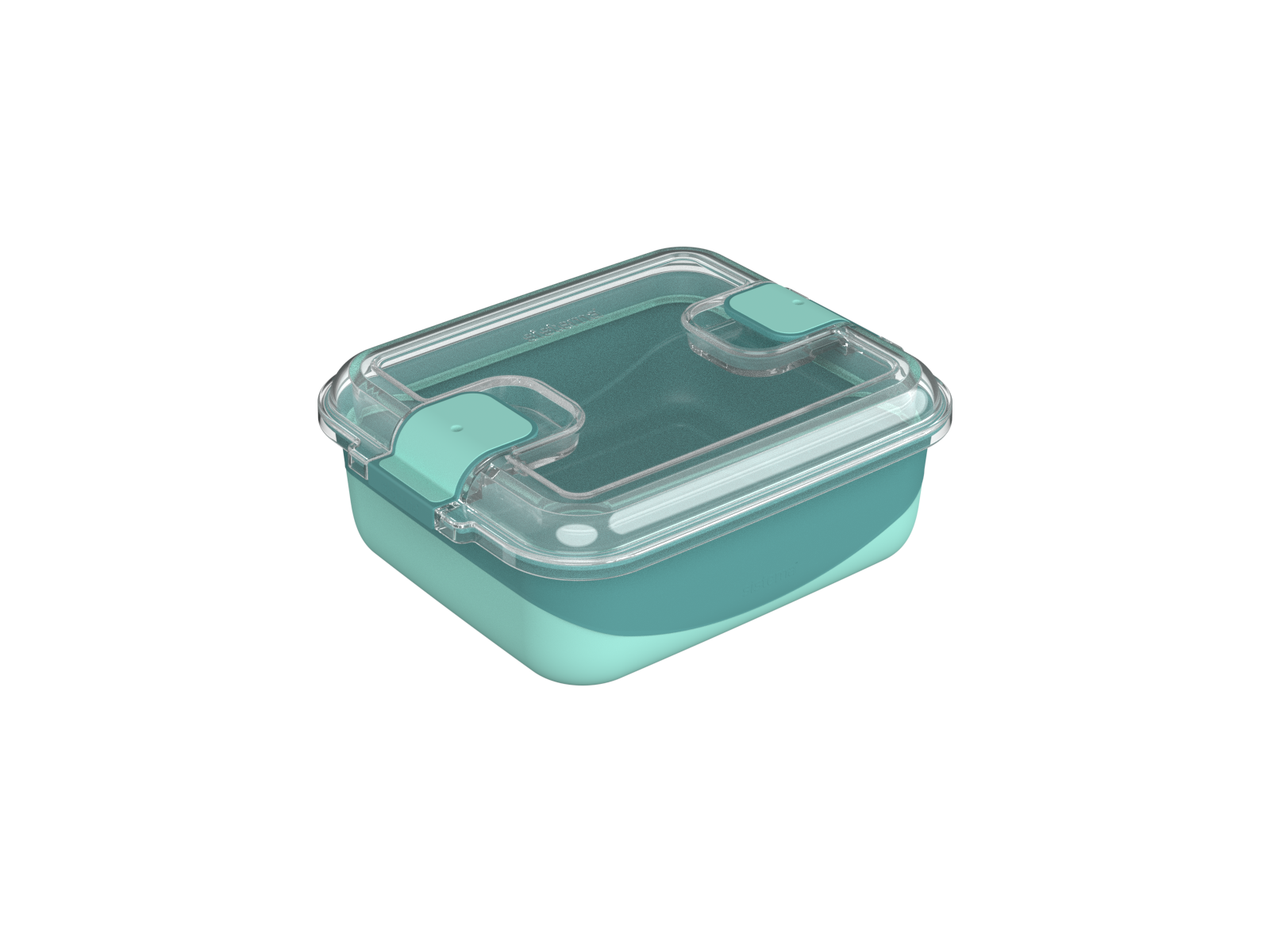
1L Large
Full Portion
£6.99
AUD $10.19 – $14.99
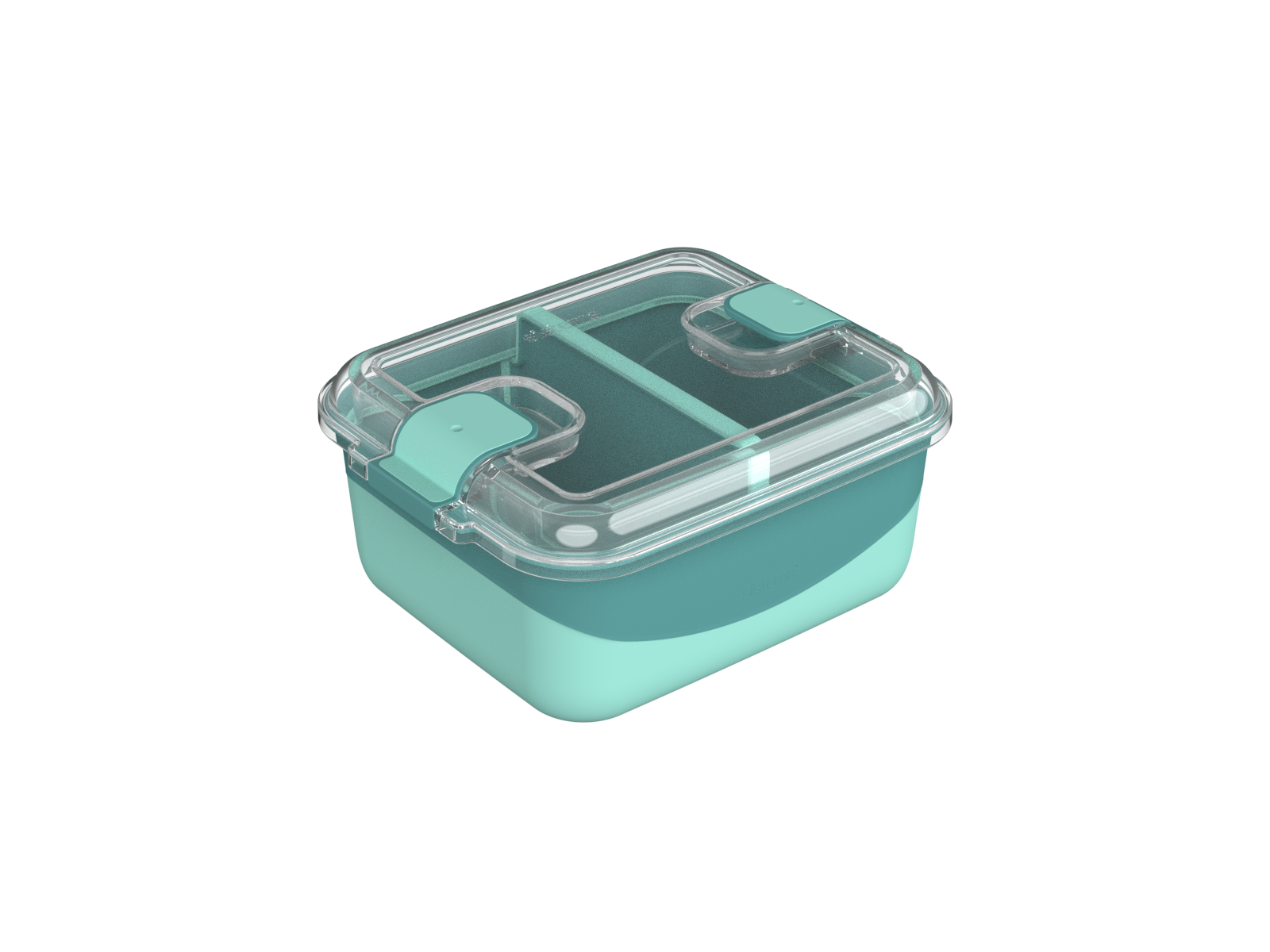
1.35L with Insert
For Variety
£8.99
AUD $11.49 – $16.99
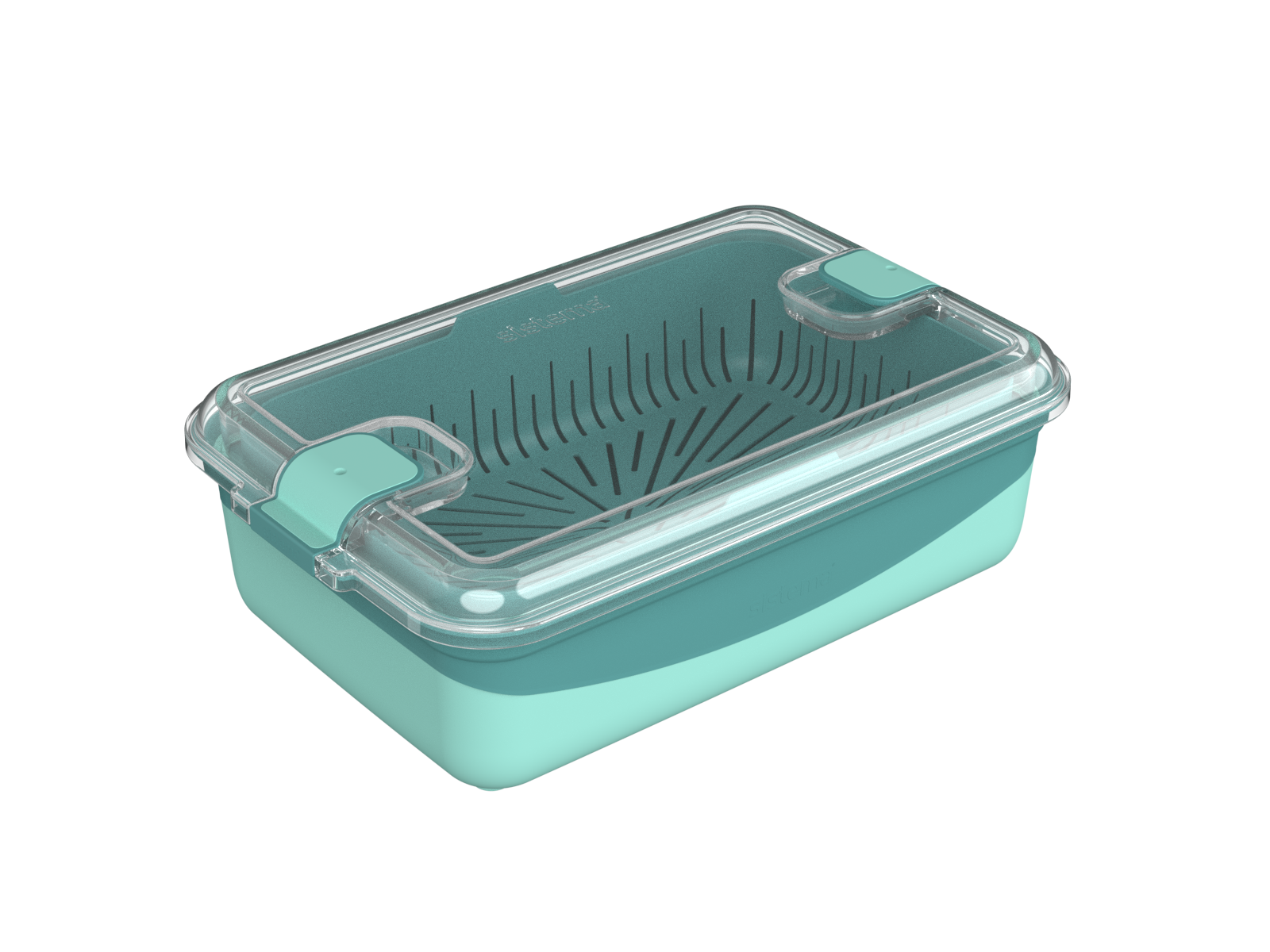
2.45L with Insert
For Steaming
£11.99
AUD $13.59 – $19.99
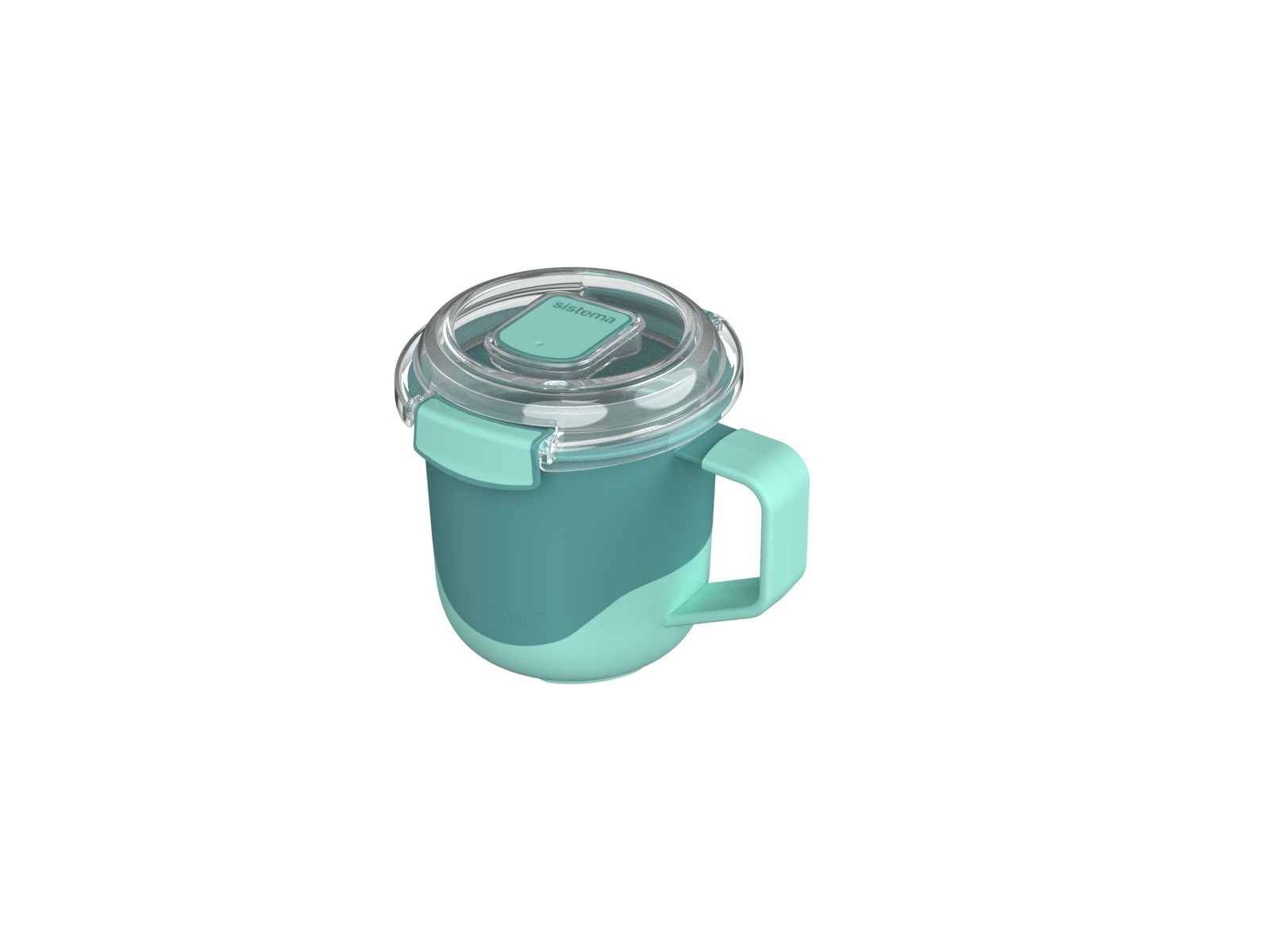
660ml Soup Mug
£6.99
AUD $8.79 – $12.99
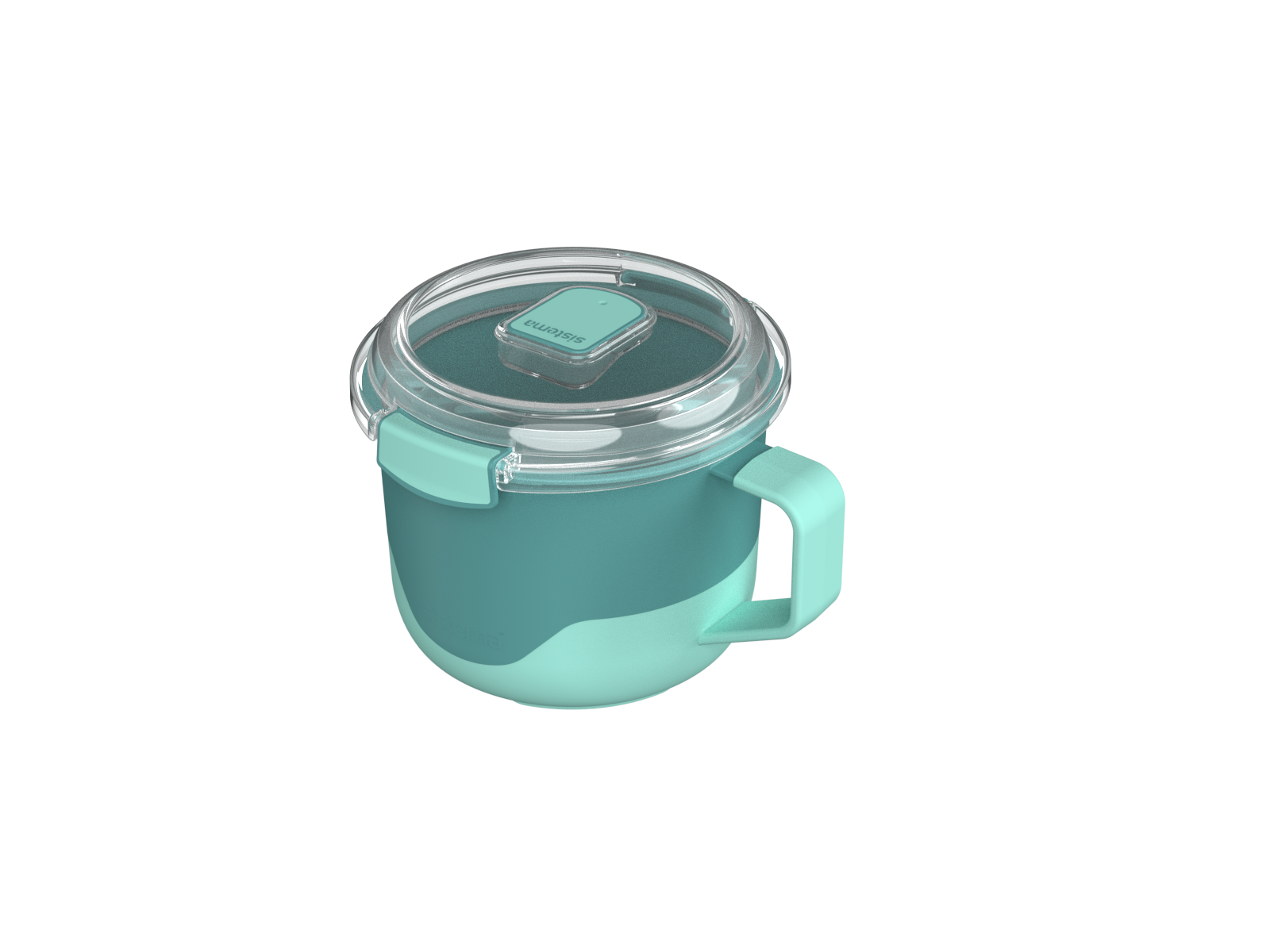
1.15L Noodle Bowl
£7.99
AUD $10.19 – $14.99
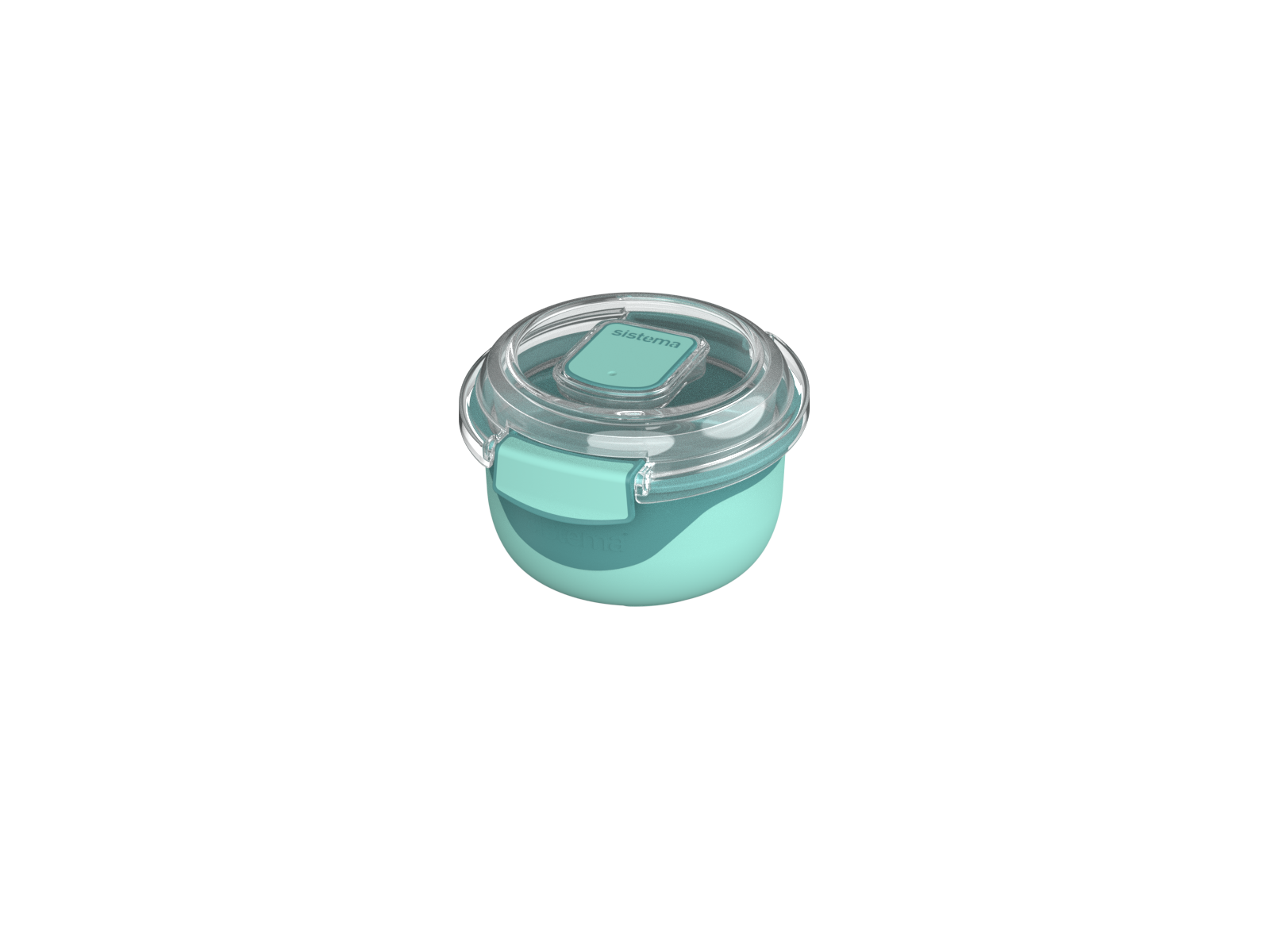
360ml Small Bowl
Breakfast
£5.99
AUD $8.79 – $12.99
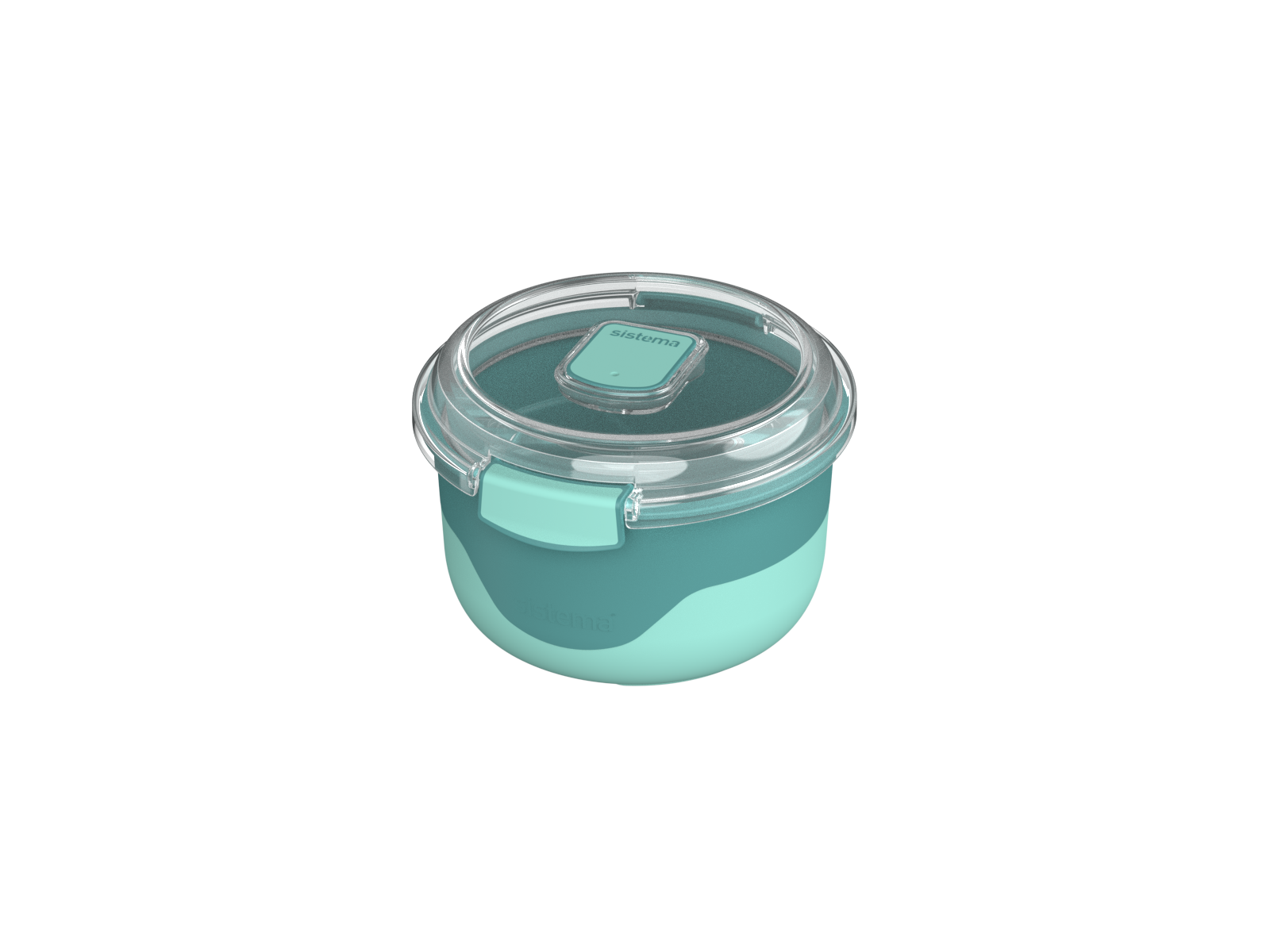
900ml Large Bowl
Rice Cooker
£6.99
AUD $10.19 – $14.99
3Pack Rectangles (Design CAD)
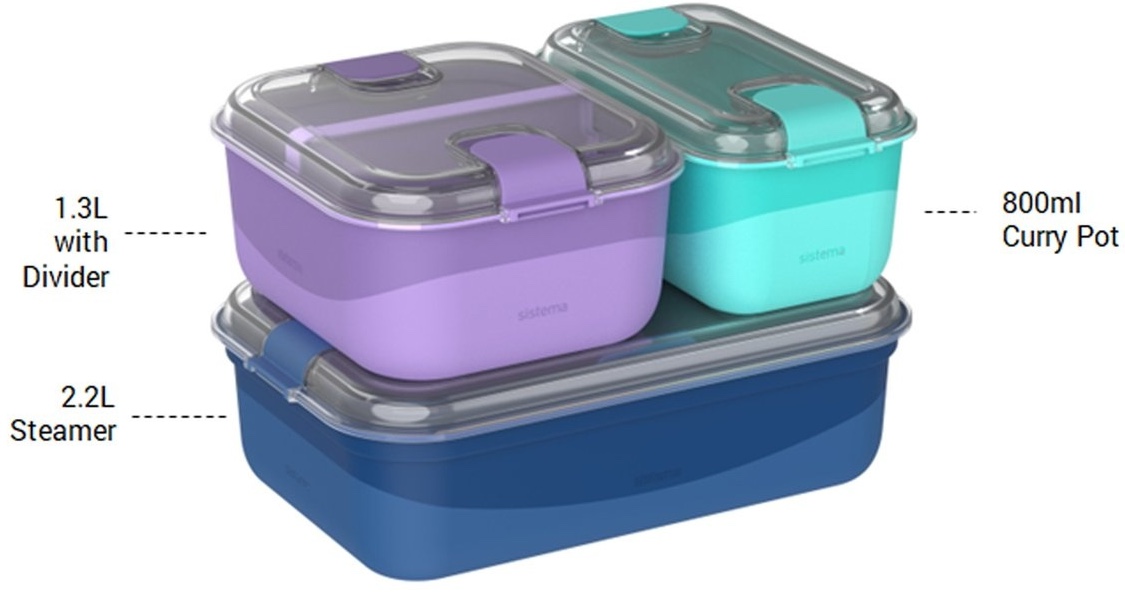
3Pack rectangles and 2Pack Rounds (Production CAD)
Design for Manufacturing
Technical Specifications
Manufacturing Approach
The MicroBento clip is produced using a 3-shot injection moulding process — a single tool that sequences three materials in one cycle, eliminating assembly labour and reducing component count.
Shot 1 — PP base: Coloured PP forms the base body.
Shot 2 — PP Lid: Clear PP fills lid cavities. Part thickness is high at 2.5mm to reduce deformation through repeated microwave use.
Shot 3 — TPE Base and Seal: TPE overmoulds on PP base and forms the leakproof wiper seal on the lid.
All materials are food-contact compliant — PP and TPE grades specified to meet FDA and EU food-safety regulations.
Stage-gate outcome: The TPE sleeve was originally specified to support an insulated safe-hold feature claim. Performance testing did not validate sufficient thermal insulation, so the feature claim was reduced to non-slip base only — a direct result of stage-gate qualification.
Market Validation
Customer feedback
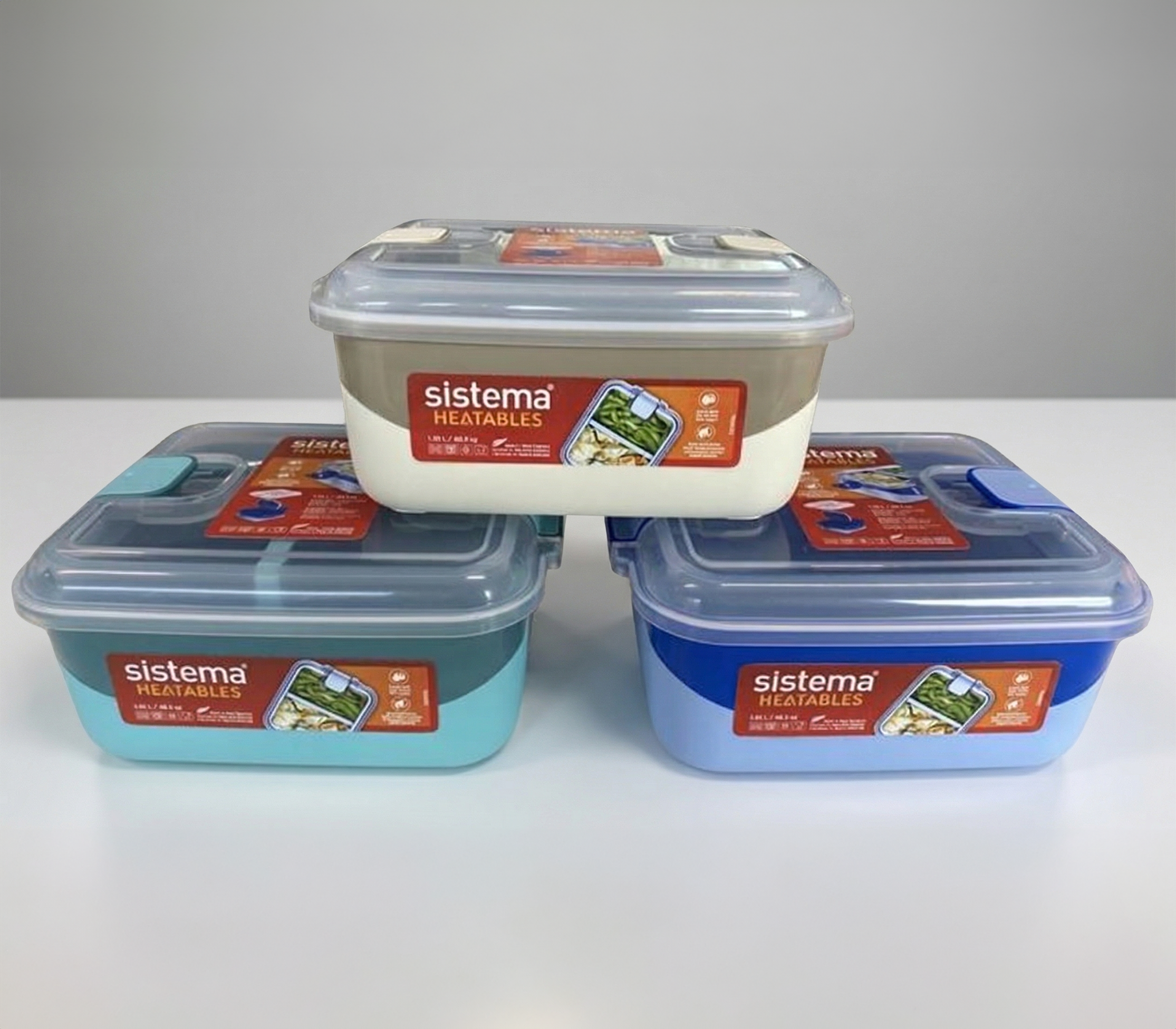
Big W — Food Storage & Lunch Buyer
Presented final production samples, August 2025
-
"Very high quality product — one of the strongest designs she has seen for a while."
-
Impressed by the quality, functionality, colours, and weight of the overall product.
-
The auto lid lift was called out as a standout feature — no competitor offers it. Identified as a key opportunity to leverage in marketing.
-
Buyer believes in the product and its unique features versus the competitor range — including Décor Microsafe and Vent & Seal.
Source: Sam Ward, Big W National Account Manager — Newell Brands, August 2025
Programme Management
How I led this
This was an 18-month end-to-end NPD programme spanning front-end innovation through to tooling sign-off — coordinated across five functions: R&D, IP & Legal, CMF, Marketing, and Manufacturing. As the programme lead, I owned the brief definition, research strategy, concept selection, and design delivery, while managing alignment across teams without direct line authority over any of them.
Key Decisions Owned
-
Pivoted brief from incremental improvement to IP-protected innovation — escalated and approved at senior leadership level
-
Resolved a three-way conflict between branding, tooling quality, and planogram requirements through a single clip-wall design change
-
Defined visual brand language across the Heatables Range to manage manufacturing cost by reusing parts across products to deliver range breadth at retail
Stakeholders Managed
-
R&D & Engineering — mechanism feasibility, design specifications BOMs, stage-gate milestones
-
IP & Legal — patent filing strategy and co-inventor coordination
-
Consumer Insights — global market test design and validation threshold alignment
-
Marketing & Sales — range architecture, seasonal CMF proposal decks, and planogram strategy across ANZ, NA and EMEA
-
Manufacturing — DfM reviews, SLA prototype sign-off, tooling cost and material compliance
Outcomes & Impact
What this delivered
$40M*
USD revenue target — launching ANZ, NA & EMEA June 2026
Invoice sales to date: $20.7M USD ahead of June launch
90%+
Concept validation — global market test, Tier 2 (>$20M) project standard
Tested by Newell Brands Consumer Insights Team, 2025
1
Patent-pending co-invention — integrated lever lift mechanism filed with IP & Legal
Patent filed in USA and ANZ
18mo
NPD cycle — concept to tooling sign-off across 5 functions and 3 global markets
8
Launch-ready SKUs — shared tooling architecture across rectangular and round formats
* $40M USD is a 3-year revenue projection across ANZ, NA and EMEA markets.
Reflections
What I'd do differently
If running this programme again, I would bring Manufacturing into the ideation phase earlier — the 3-shot tooling decision was made mid-development and, while it proved to be the right call, earlier manufacturing input would have reduced iteration cycles on the clip geometry. I would also expand the primary research sample and geographic spread beyond Auckland; the 63-person questionnaire was directionally strong but a broader, multi-market dataset would have given the brief greater rigour at senior stakeholder review.
The pivot from aesthetic differentiation to IP-protected design was the most consequential decision on this project — and it came from directly using the existing product, observing its shortcomings first-hand, and recognising that the real gap was in the product experience, not just aesthetic. That's a lesson I carry forward: the most important strategic insights often surface through hands-on experience in the field, not in the boardroom.